What TV doesn't, print can't; we deliver.
What TV doesn't, print can't; we deliver.
What TV doesn't, print can't; we deliver.
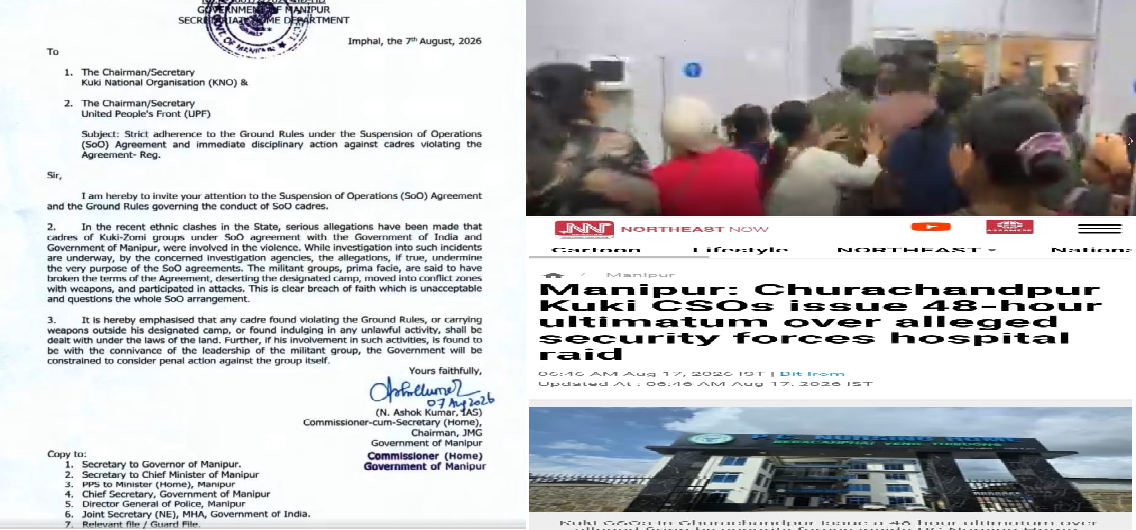
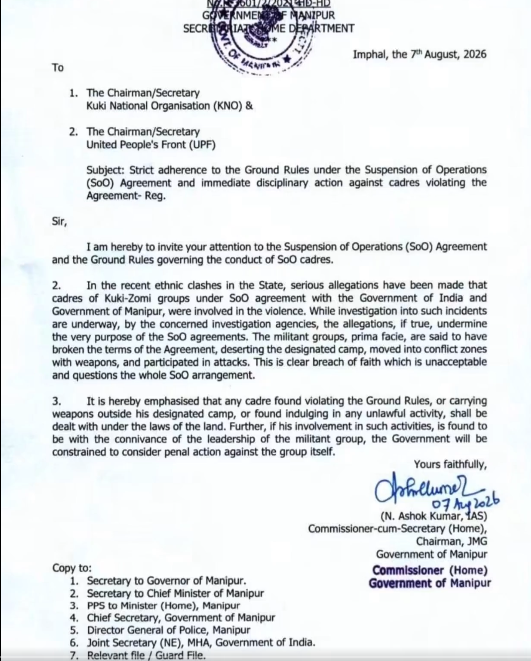
The 7th August letter from N. Ashok Kumar, Chairman of the Joint Monitoring Group, the tripartite mechanism responsible for supervising and enforcing the ground rules of the Suspension of Operations (SoO) agreement, finally delivers a stern written warning to Kuki terrorist groups operating under the arrangement that is available on public domain.
The message acknowledges that serious allegations have emerged of SoO cadres violating the ground rules, engaging in violence and entering conflict zones. The letter terms such conduct as a breach of faith that raises fundamental questions about the entire agreement. Any cadre found violating the ground rules or engaging in unlawful activity will be dealt with according to law. If group leadership is found to have ignored, tolerated or participated in such violations, penal action could extend to the entire organisations.
The warning is a bitter indictment of how long enforcement has been absent.
The SoO agreement was signed in 2008 between the Government of India, the Government of Manipur and Kuki armed organisations represented by the Kuki National Organisation (KNO) and the United People’s Front (UPF). There are currently 25 armed groups under the arrangement.
For eighteen years, the state has possessed a mechanism specifically intended to restrain these armed organisations. Yet enforcement has repeatedly failed.
More strikingly, serious governmental resolve appears to have arrived only after three years of devastating violence. At least 160 people, including 14 security personnel, have lost their lives since the present conflict began, amid numerous killings and other acts of violence allegedly involving Kuki terrorist cadres, including individuals alleged to have links with SoO groups.
The question now is whether it will finally enforce the ground rules.
A warning will mean little unless the loopholes that have undermined the SoO framework for years are closed.
First, armed groups cannot be political instruments.
Successive state and central governments, irrespective of political party, have at various times treated armed organisations and their networks as useful political muscle. That is fundamentally incompatible with serious enforcement.
A terrorist organisation cannot be treated as a security threat when inconvenient and a political asset when useful.
If the Government genuinely intends to enforce the SoO ground rules, political patronage must end.
Second, security forces must be allowed to enforce the law.
Security personnel cannot enforce arrests or conduct operations if organised civilian resistance can obstruct them and subsequently demand action against the personnel involved.
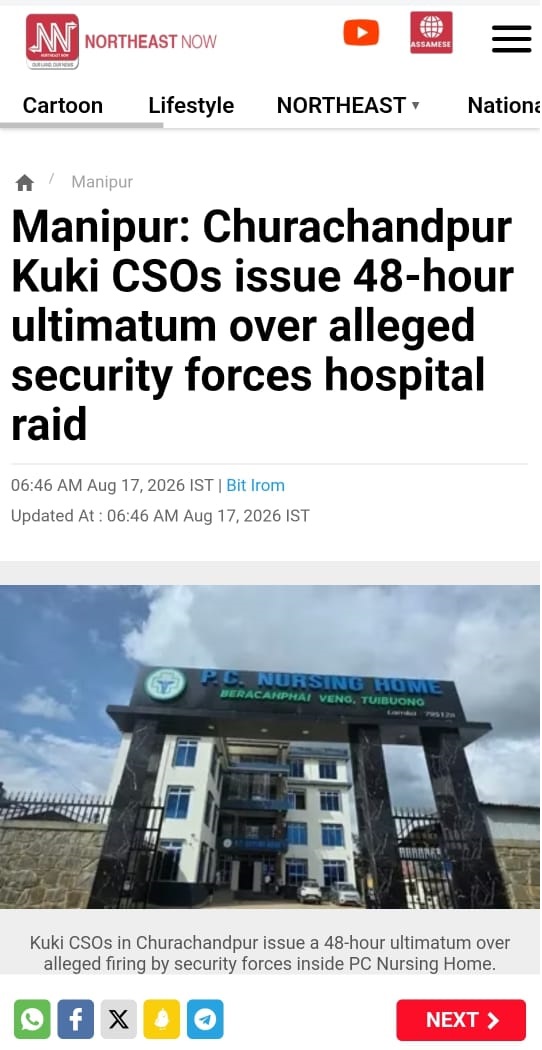
The reported 15 August incident at PC Nursing Home in Churachandpur illustrates the problem. Kuki civilians, including women, reportedly prevented security forces from arresting a suspected Kuki terrorist undergoing treatment. Six Kuki civil-society organisations subsequently issued a 48-hour ultimatum demanding suspension and prosecution of the personnel involved.
Whatever the political circumstances, civilians cannot be permitted to obstruct lawful security operations and security personnel cannot be penalised merely for attempting to arrest an accused terrorist.

Third, the revolving door between SoO and non-SoO groups must end.
A major enforcement vulnerability exists when cadres can allegedly participate in violence under the banner of a non-SoO formation and later return to an SoO camp and claim protection as members of a recognised group.
The Government must maintain a continuously updated register of every SoO cadre, including identity, biometric details, designated camp and authorised movements. It must also establish whether individuals are simultaneously participating in non-SoO armed activity.
Fourth, SoO camps must not become revolving doors.
Remote camps and limited monitoring capabilities make it possible for cadres to leave, travel through sympathetic territory, allegedly commit unlawful acts and return before the next physical verification.
Physical verification alone is therefore inadequate.
Unannounced inspections, biometric attendance, movement records and effective accountability for camp commanders are necessary. The Government must know not merely who is registered inside an SoO camp, but who is actually there.
Indian taxpayers have funded stipends and other benefits for cadres covered by the SoO framework. If individuals receiving public money subsequently participate in violence against civilians or security forces, the system has failed at its most basic level.
Violations should trigger immediate suspension of benefits, investigation and prosecution where warranted and removal from the SoO framework when culpability is established.
A letter is not enforcement.
Arrests, investigations, camp inspections, prosecution of offenders, removal of violators and action against organisations whose leadership knowingly facilitates violations are what will determine whether this warning has any credibility.
After three years of violence and at least 160 lives lost, the Government cannot afford another cycle of stern statements followed by inaction.
A terrorist group does not become legitimate merely because it signs a ceasefire agreement. A ceasefire does not confer immunity. An SoO camp cannot become a sanctuary from the law.
The Government has finally signalled that the rule of law will apply. It must now prove it.
Otherwise, the 7 August letter will become exactly what so many previous warnings have become:
an empty threat.