What TV doesn't, print can't; we deliver.
What TV doesn't, print can't; we deliver.
What TV doesn't, print can't; we deliver.
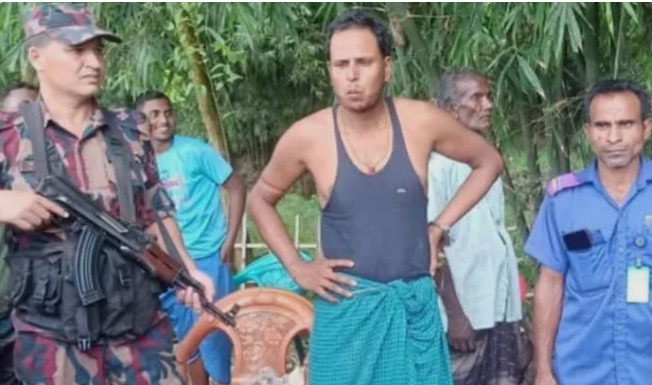
Bangladeshi authorities are holding Indian farmer Dipankar Gope after he was dragged across the international border on 7th August. His release has been linked to the demand that India free Tamiz Uddin, a Bangladeshi national believed to have links with a cross border smuggling network, who was detained by the BSF after entering India by cutting through the border fence on 4th August. Three flag meetings have failed to resolve the standoff.
The abduction of a 35-year-old Indian tea farmer from West Bengal’s Jalpaiguri district has turned a border incident into a serious test of India’s ability to protect its citizens and enforce the integrity of its international frontier.
Dipankar Gope was working in his tea garden near Gate No. 30 of the Chaulhati Border Outpost under Rajganj block, within approximately 150 yards of the India-Bangladesh border fence, when a group of around 15–20 Bangladeshi men crossed into Indian territory, overpowered him and forcibly dragged him across the international border into Bangladesh’s Panchagarh district.
The men who took Gope said the abduction was retaliation for the arrest of Tamiz Uddin.
A video that has emerged from the incident shows Gope stating that he would be released if India released Tamiz Uddin. BGB personnel are visible alongside local villagers in the footage.
Gope’s father appealed for his son’s safe return on August 8. The appeal did not result in his immediate release.
The incident has understandably caused alarm in villages along the border. Farmers living and working near the fence routinely cultivate land in areas where the international boundary is physically close to their fields. If armed or organized groups can cross into India, seize an Indian farmer in broad daylight and take him across the border, the implications extend far beyond one family.
The BSF has repeatedly sought Gope’s immediate and safe return from the BGB, maintaining that he was taken from Indian territory. Instead, Gope was handed over to Bangladeshi police and subsequently charged with illegal entry into Bangladesh.
The absurdity of the situation is stark: an Indian citizen forcibly taken across an international border is now being prosecuted by the country into which he was dragged.
Three major flag meetings between the BSF and BGB have reportedly been held to resolve the matter. All three ended without a breakthrough. Gope’s family and the Confederation of Indian Small Tea Growers’ Associations (CISTA) have written to Union Home Minister Amit Shah, seeking direct intervention from the central government and diplomatic engagement with Dhaka.
The episode is particularly disturbing because a similar pattern has been reported elsewhere along the India-Bangladesh border.
In another incident, Bangladeshi villagers crossed into Indian territory and forcibly took two Indian farmers Sachin Das and Narottam Biswas while they were harvesting jute on the Indian side. Their seizure was linked to demands for the release of Abdul Mannan, a Bangladeshi national detained by the BSF for illegal entry into India and suspicious movement.
The message created by such incidents is :
” An individual detained by Indian authorities can become a bargaining chip and Indian civilians can be seized to force India’s hand”
That precedent cannot be allowed to take root.
India has every right—and every responsibility—to enforce its international border.
If a person cuts through a border fence and illegally enters India, Indian authorities are entitled to detain and investigate him in accordance with Indian law. The answer to that detention cannot be the abduction of an Indian farmer.
Nor can the subsequent prosecution of the abducted Indian citizen in Bangladesh erase the circumstances under which he was taken there.
India’s response therefore needs to be firm, immediate and unmistakable.
The government should make clear to Dhaka that the release and safe return of Indian citizens abducted from Indian territory is not a bargaining matter. Border negotiations cannot become mechanisms through which civilians are exchanged for individuals detained after illegally entering India.
The government must also ensure that the BSF has the resources, intelligence and operational protocols necessary to prevent such incidents and to respond immediately when civilians working close to the border are threatened.
And if diplomatic and operational constraints prevent the immediate resolution of individual cases, the government has another obligation: protect the people who have to live and work on the frontier.
Farmers whose legally cultivated land lies beyond or close to the border fence should not be left to fend for themselves. They need clear security protocols, reliable communication with the BSF, rapid-response mechanisms and practical training on what to do if hostile groups cross the border or attempt to abduct them.
The international border is not an abstract line on a map. For thousands of Indian farmers, it runs alongside their fields, their homes and their livelihoods.