What TV doesn't, print can't; we deliver.
What TV doesn't, print can't; we deliver.
What TV doesn't, print can't; we deliver.
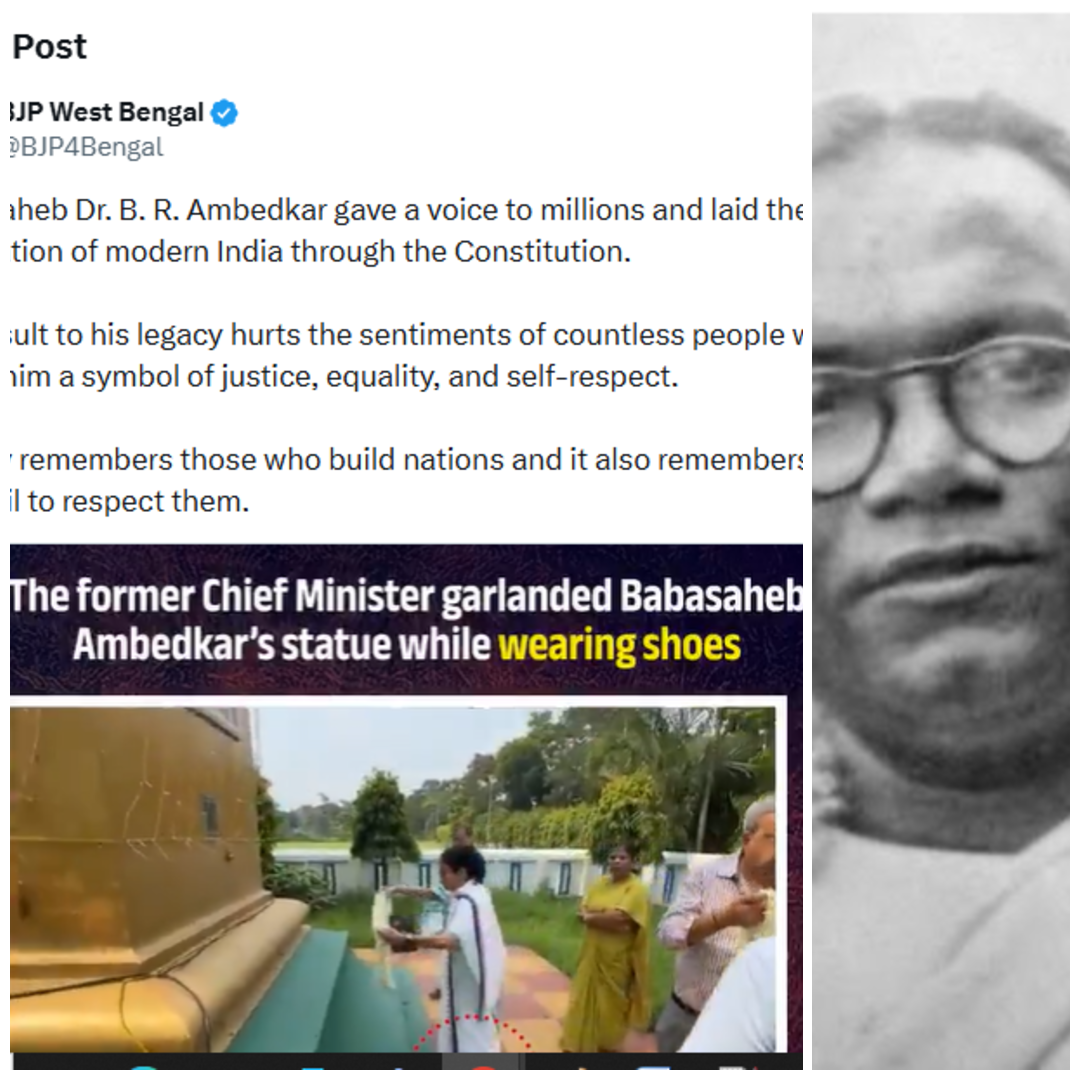
Most Indian states debate the merits of identity politics in theory. Bengal has already tested it in practice. The result was one of the greatest civilizational ruptures in modern Indian history.
West Bengal is perhaps the only state in India whose modern history contains a complete political laboratory for examining both the promises and the perils of identity-based coalition politics. That experiment was conducted by Jogendra Nath Mandal. Its outcome was Partition.
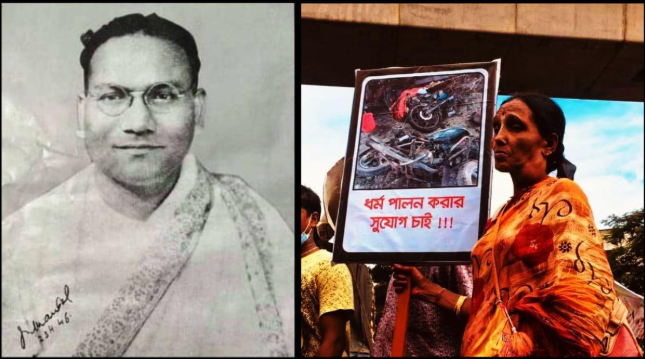
The Bharatiya Janata Party therefore faces a strategic question that extends far beyond electoral calculations. Should it build its politics in Bengal around the state’s own civilizational memory and historical experience, or should it import political frameworks that emerged under very different social and historical conditions elsewhere in India?
This question has acquired new relevance as sections of the BJP increasingly embrace Ambedkarite political symbolism. Dr. B. R. Ambedkar was unquestionably an important constitutional thinker, jurist and social reformer whose contributions deserve recognition. Yet the issue before Bengal is not the personal stature of Ambedkar. The issue is whether a political framework organized primarily around caste identity is compatible with Bengal’s unique historical experience and strategic realities.
A distinction must be made between respect and deification. Modern political discourse often treats any critical examination or historical contextualization of Ambedkar as illegitimate. Such an approach is neither intellectually healthy nor historically accurate. Ambedkar contributed significantly to the framing of India’s Constitution, but claims that he “created India” or “built the nation” blur the distinction between the Indian nation and the modern Indian state. Bharat existed as a civilization, cultural sphere, sacred geography and political idea for millennia before the Constitution was drafted. The Constitution provided institutional form to the Republic of India; it did not create Indian civilization.
Yet the central question remains whether Ambedkarite identity politics is strategically suited to Bengal?
To answer that question, one must first understand Jogendra Nath Mandal.
Mandal emerged as one of Bengal’s most influential Scheduled Caste leaders during the final years of British rule. His political project rested on a simple but consequential proposition that caste identity constituted the primary political reality of Indian society and that alliances built upon caste arithmetic could overcome deeper civilizational, religious and historical loyalties. From this perspective, an alliance between Scheduled Castes and the Muslim League appeared not merely possible but politically advantageous.
The fundamental error of Mandal’s project was the assumption that caste solidarity would prove more durable than civilizational and religious solidarity.
History delivered a different verdict.
When the crisis of Partition arrived, the political arithmetic upon which the alliance had been constructed collapsed under the weight of larger historical forces. The consequences extended far beyond elections or legislative representation. What followed was Partition, mass displacement, communal violence, the destruction of centuries-old communities and the uprooting of millions of Hindus from lands they had inhabited for generations. Mandal himself ultimately became disillusioned with the political order he had helped create and resigned after witnessing the treatment of Hindu minorities in Pakistan.
The lesson of this history is not that Ambedkar and Mandal were identical figures, nor that contemporary circumstances are identical to those of the 1940s. Historical analogies are rarely useful when applied mechanically.
The lesson lies in the underlying political logic.
When political actors begin to view society primarily as an aggregation of competing identity blocs, they risk subordinating national, civilizational and strategic interests to short-term political calculations. Electoral coalitions built around sectional identities may deliver immediate gains, but they can also weaken the broader social cohesion upon which stable political communities ultimately depend.
For most Indian states, the consequences of such fragmentation are largely electoral. Governments change. Coalitions rise and fall. Political power shifts from one group to another.
West Bengal is different.
West Bengal is not merely a state. It is a frontier.
It shares a long and sensitive international border. It has experienced decades of illegal immigration, refugee movements, demographic transformation in several districts, cross-border criminal networks and recurring communal tensions. These realities place Bengal in a strategic category fundamentally different from that of most Indian states.
In most states, identity politics determines who governs. In Bengal, it can help determine the future character of the frontier itself.
The stakes are therefore not merely electoral. They are civilizational and geopolitical.
For this reason, political frameworks that encourage citizens to think of themselves primarily as members of separate caste constituencies rather than participants in a broader civilizational community carry risks that extend beyond ordinary politics. Such frameworks may produce short-term electoral advantages, but they can simultaneously weaken the social consensus required to address questions of border security, illegal immigration, demographic pressures, and national cohesion.
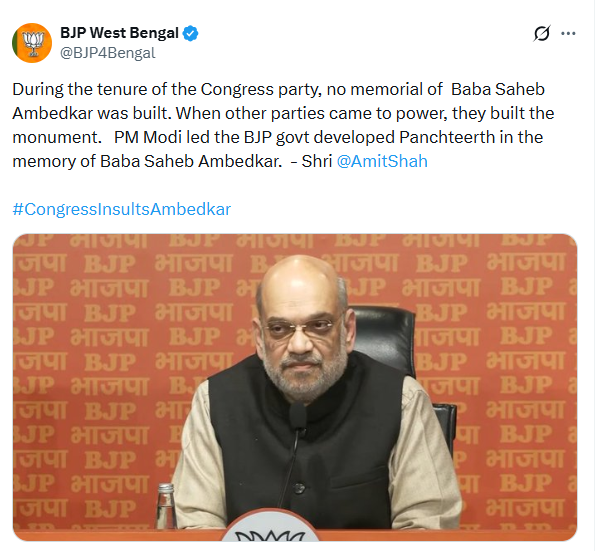
This is why the debate surrounding Ambedkarite politics in Bengal cannot be reduced to symbolism, representation, or electoral strategy. The issue is not whether Ambedkar deserves respect. The issue is whether a political framework centered on caste identity is appropriate for a border state confronting challenges that demand the widest possible sense of civilizational and national solidarity.
The BJP’s comparative advantage in Bengal does not lie in competing with its opponents over displays of reverence toward Ambedkar. Nor does it lie in replicating political formulas developed elsewhere. Its natural strength lies in Bengal’s own historical inheritance.
The Bengal Renaissance, the anti-Partition movement, the refugee experience and the intellectual legacy of Shyama Prasad Mookerjee, Bankim Chandra Chattopadhyay, Swami Vivekananda, Sri Aurobindo and countless others provide a political vocabulary far more relevant to Bengal’s contemporary challenges than imported frameworks of identity mobilization.
Every political tradition chooses its historical reference points. The question is not whether Ambedkar deserves a place among India’s national figures. The question is whether Ambedkarite identity politics should occupy the center of Bengal’s political imagination.
History rarely repeats itself through identical events. It repeats itself through recurring political assumptions. Jogendra Nath Mandal believed that identity arithmetic could safely override deeper civilizational realities. Bengal paid dearly for that assumption. The question before the BJP is not whether it respects Ambedkar. The question is whether it has learned the central political lesson of Bengal’s twentieth century.
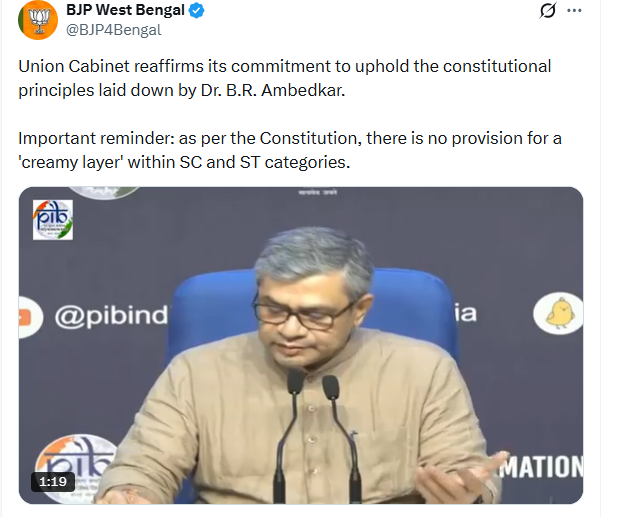
The responsibility of contemporary political leadership is not to repeat the logic of that mistake under a different banner, but to build a politics rooted in Bengal’s own civilizational memory, one capable of preserving national unity, maintaining social cohesion and safeguarding the security of India’s eastern frontier.