What TV doesn't, print can't; we deliver.
What TV doesn't, print can't; we deliver.
What TV doesn't, print can't; we deliver.
At stake in the battle over the largest murti of Prabhu Shri Ram in Bangladesh is far more than the future of a single religious monument. The controversy has become a test of whether Bangladesh’s Hindu minority can openly practice and publicly express its faith in the face of organised intimidation, extremist mobilisation and explicit threats of mob violence. What began as an uncontroversial temple development project has been transformed into a national flashpoint, raising fundamental questions about religious freedom, minority rights, and the ability of the state to protect vulnerable religious minorities from campaigns of sectarian hostility.
The construction of the Shri Ram murti proceeded openly and without controversy as part of the development of the Sri Sri Radha Govinda and Kali Temple complex for nearly two years. That changed abruptly in the first week of June, when a coordinated campaign of online agitation emerged targeting not only the proposed murti but Bangladeshi Hindus themselves. Organisers and supporters disseminated derogatory content, sectarian propaganda and hate speech directed at Shri Ram, Hindu religious practices and Bangladesh’s indigenous Hindu minority through social media platforms. What began as an online campaign soon evolved into a nationwide movement of organised mobilisation.
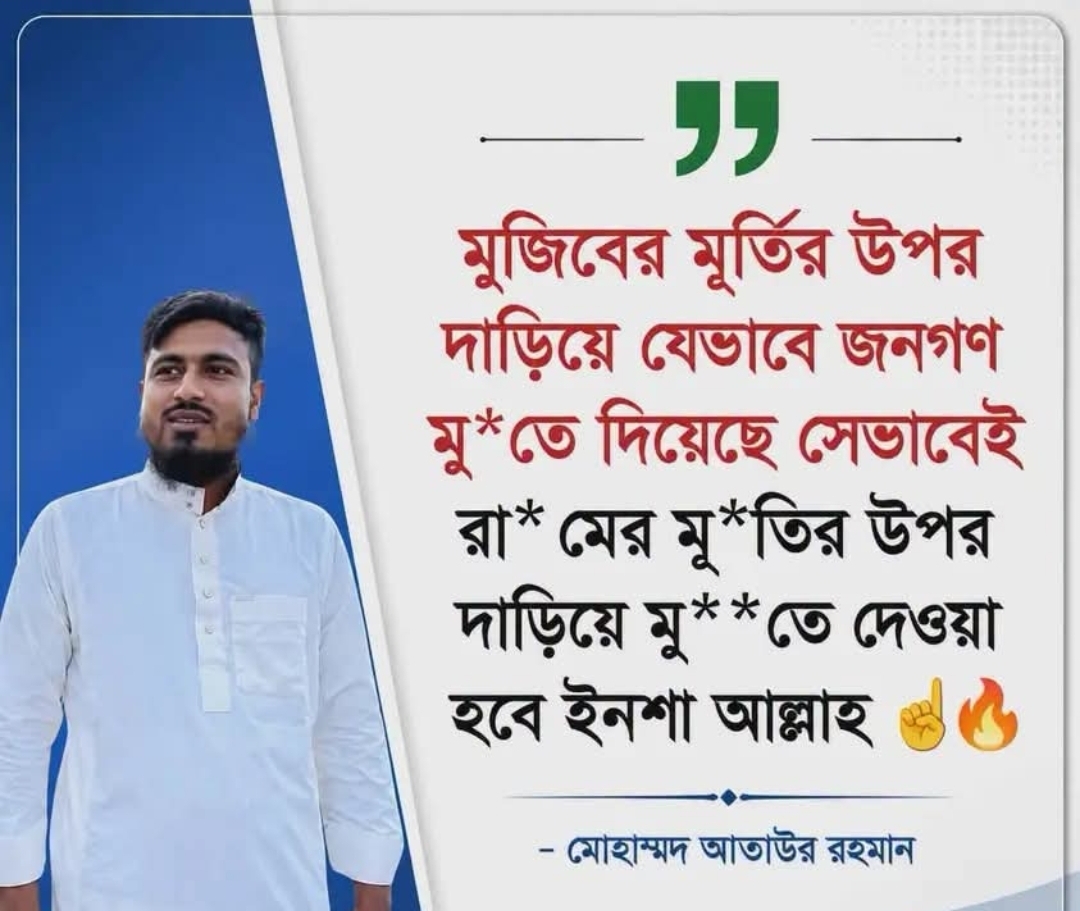
Our previous investigative report documented how this campaign was systematically amplified by Islamist hardliners and extremist figures, including Jashimuddin Rahmani, the spiritual leader of the Ansarullah Bangla Team (a designated terrorist organisation) and Ataur Rahman Bikrompuri, Amir of Azadi Andolon Bangladesh [1]. Bangladeshi counter-terrorism agencies and major national media outlets have consistently identified Bikrompuri as a radical Islamist preacher. In November 2025, he was arrested on allegations of inciting mob violence against prominent media organisations, including The Daily Star and Prothom Alo. Their intervention helped transform a local religious project into a national political and sectarian controversy.
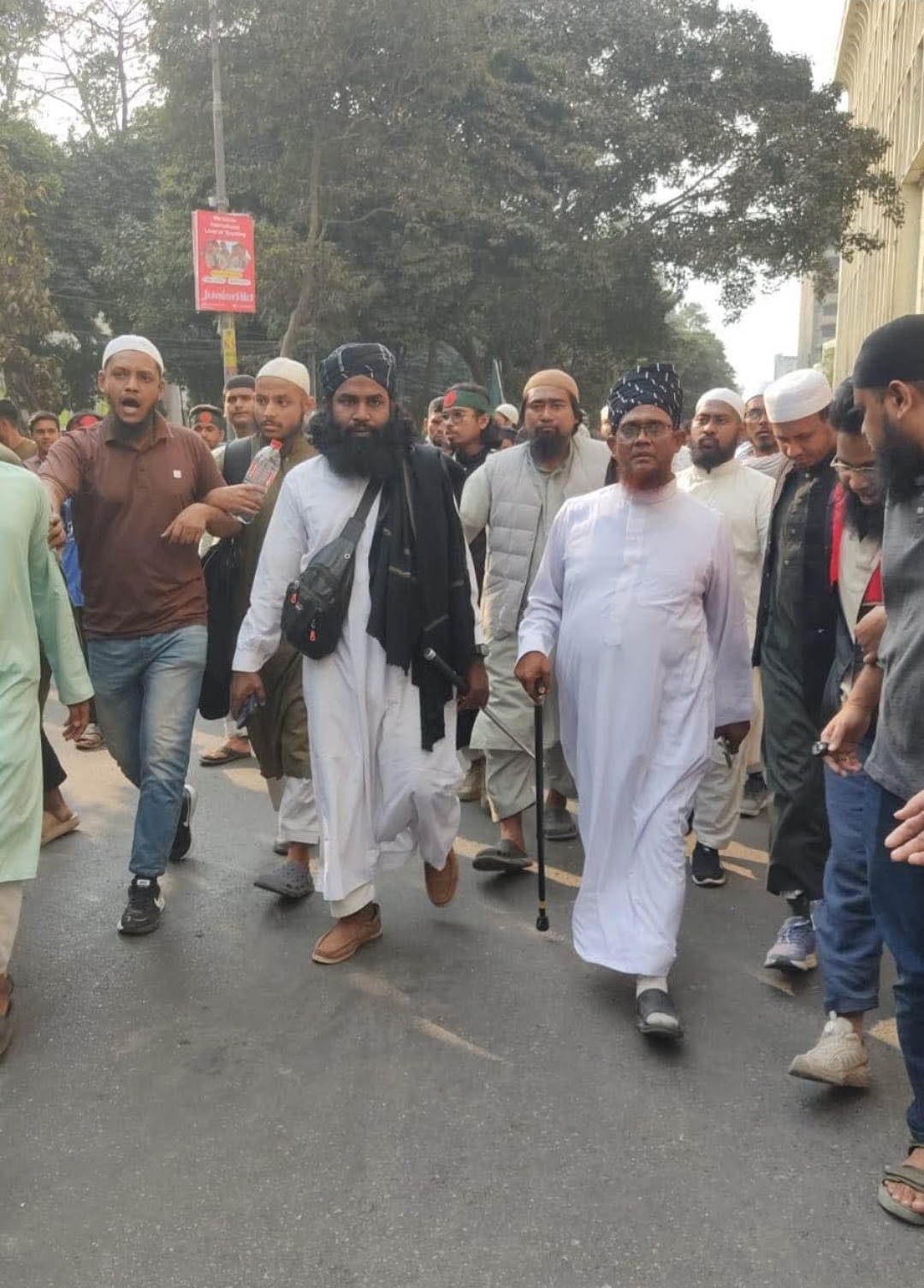
The online campaign was rapidly translated into coordinated street mobilisation by organisations including Insaf Kayemkari Chatra Sramik Janata, Imam Ulema Council, Islami Chhatra Shibir, Hefajot-e-Islam and Touhidi Janata. Protest leaders publicly demanded the dismantling of the murti and repeatedly portrayed its existence as unacceptable within Bangladesh. Several clerics like the leader of Insaf Kayemkari Chatra Sramik Janata and organisers escalated their rhetoric further, openly threatening extra-judicial action and warning that the murti would be demolished by the public.
Demonstrators were recorded repeatedly striking an image of Shri Ram with sandals and slippers during a protest rally in Gaibandha on 12th June, an act widely perceived by Bangladesh’s Hindu community as a deliberate attempt to insult a revered religious figure, humiliate an already vulnerable minority and inflame communal tensions. Far from being an isolated incident, it reflected a broader pattern of dehumanising rhetoric, public hostility and intimidation directed at Hindus throughout the controversy.
Despite repeated appeals from Hindu organisations, community leaders and temple authorities across the country, the Government failed to provide adequate security guarantees for the under-construction murti and the surrounding temple complex. Nor were effective measures taken to curb the escalating campaign of hate speech, threats and intimidation being propagated both online and on the streets. Faced with mounting security concerns, growing fears of violence and the absence of meaningful state protection, the Sri Sri Radha Govinda and Kali Temple Committee announced an indefinite suspension of construction activities related to the Shri Ram murti.
The indefinite suspension of the Shri Ram Murti project was widely expected to defuse tensions and bring an end to the controversy surrounding the Sri Sri Radha Govinda and Kali Temple complex. Instead, it exposed a more troubling reality. Even after the temple committee halted construction indefinitely, the hostility directed at Shri Ram, the temple complex and Bangladesh’s Hindu minority continued unabated. The concession extracted from a vulnerable religious community failed to satisfy those who had mobilised against the project. Rather than restoring calm, the suspension is demonstrating that the controversy has evolved beyond a dispute over a monument and become part of a broader challenge to Hindu religious expression itself.
Had the controversy genuinely centred on concerns relating to a specific construction project, the suspension of that project should have reduced tensions. Instead, threats, propaganda and hostility persisted. The continuation of the campaign after its stated objective had effectively been achieved raises an uncomfortable question:
Was the goal the removal of a particular murti, or the re-establishment of a broader principle that public expressions of Hindu religious identity could be challenged, restricted, or suppressed through sustained pressure and intimidation?
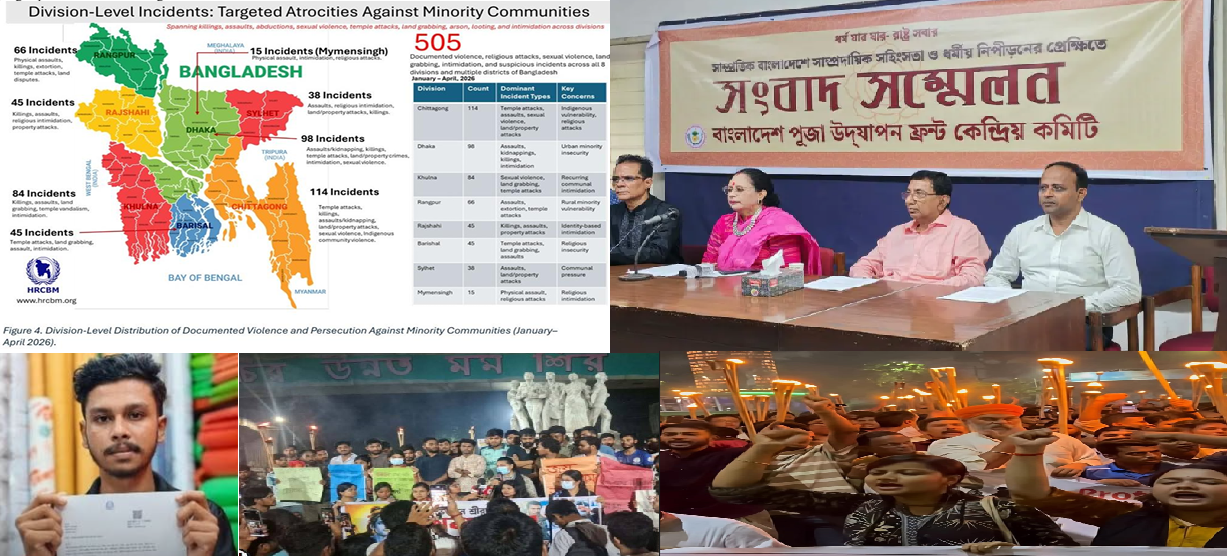
These developments unfolded against a backdrop of growing insecurity among Bangladesh’s religious minorities. Reports documenting violence, discrimination and targeted attacks against Hindus have become increasingly frequent in recent years, contributing to a climate of fear that extends far beyond any single incident. According to the Hindu Buddhist Christian Unity Council, 522 incidents of atrocities against religious minorities were documented during 2025. The trend has shown little sign of abating. The Human Rights Congress for Bangladesh Minorities (HRCBM) documented at least 502 incidents targeting Hindus across 62 districts of Bangladesh between January and April 2026 alone. These cases included 100 murders or suspicious deaths, 95 attacks on religious institutions, 28 incidents of rape or gang rape, and 144 attacks on homes, businesses and other properties belonging to religious minorities.
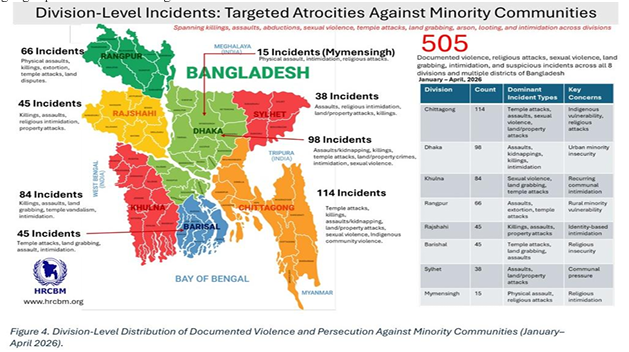
For a community comprising only 7.95 percent of Bangladesh’s population, these figures are not merely statistics. They represent hundreds of individual encounters with violence, intimidation, dispossession and fear. Taken together, they describe a level of insecurity that many Hindus increasingly view not as a series of isolated incidents but as a persistent condition of life.
Minority rights advocates further argue that even these figures may understate the true scale of the problem. Investigations conducted by The Hindu Voice Trust into anti-Hindu violence during late 2025 and between 12 and 28 February 2026 concluded that a substantial majority of incidents received little or no meaningful coverage in mainstream Bangladeshi media. In many cases, incidents were presented as generic law-and-order disturbances without reference to the communal dimensions alleged by victims and local communities.
It was within this atmosphere of insecurity that a remarkable mobilisation emerged. The protests that followed were significant not because they demanded political privilege or special treatment, but because of how limited and fundamental their demands were. Participants called for protection of basic religious freedoms, equal security under the law, an end to hate campaigns directed at Hindus and the creation of conditions under which the Shri Ram Murti could be completed without fear of violence. At their core, the demonstrations reflected a demand for the right to practise one’s faith openly, safely and without intimidation.
What followed was one of the most significant Hindu-led mobilisations witnessed in Bangladesh since late 2024. Within days, demonstrations spread from university campuses to city centres across multiple districts. Students at Jahangirnagar University organised torchlight marches. Thousands gathered at Shahbagh in Dhaka. Demonstrations, rallies, silent protests, foot marches and public assemblies were subsequently organised at Dhaka University, Hajee Mohammad Danesh Science and Technology University, Rajshahi University, Barishal University, Chattagram, and numerous other locations. Civil society organisations joined the movement, with the Bangladesh Puja Udjapon Front presenting a seven-point charter of demands focused on minority security and equal rights. The geographic breadth of the mobilisation demonstrated that the Shri Ram Murti controversy had become a symbol of broader anxieties shared by Hindu communities across the country.
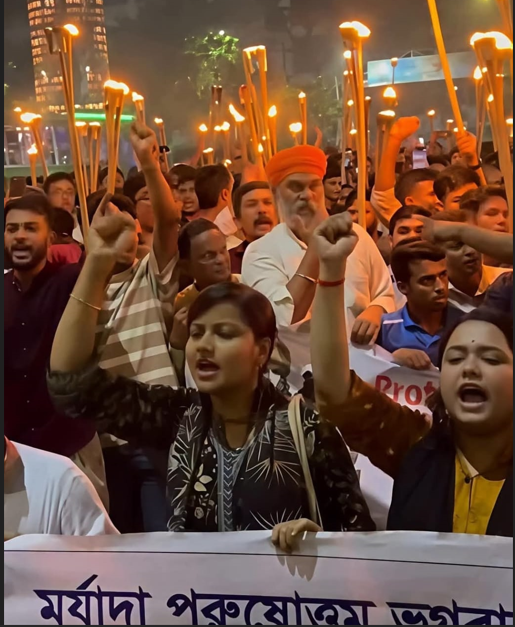
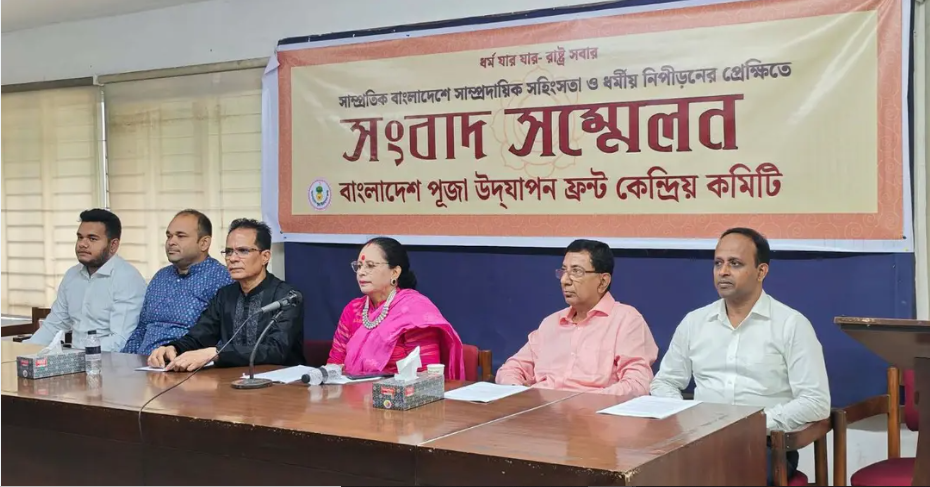
Equally significant was the profile of those leading the movement. Rather than being driven primarily by established political actors, many demonstrations were spearheaded by students, young professionals, social activists and ordinary citizens. Social worker and Human-Rights actvist Timpaul Paul filed a police complaint with GDE No : 580 and tracking number TD8WBI at the Palashbari Police Station against people desecrating the image of Shree Ram at Gaibandha, accusing them of spreading communal hatred on 13th June. This generational character reflected a growing perception among younger Hindus that silence no longer offered protection. For many participants, the issue was no longer simply the fate of a single religious monument but the cumulative effect of years of insecurity, discrimination and unresolved grievances.
As the movement expanded, so too did efforts to target its most visible voices. A disturbing pattern emerged in which prominent speakers and organisers became the subjects of coordinated online campaigns designed to discredit, intimidate or isolate them. Social media platforms increasingly became arenas for personal attacks, character assassination and the circulation of private information. In several cases, calls for harassment and even mob action were presented as expressions of patriotism or religious duty.
The experience of Dwipjoy Sarkar Dipto, Assistant General Secretary of Dhaka University Jagannath Hall Chatra Sangshad, illustrates this phenomenon. Following a speech delivered during a protest gathering at Raju Bhaskorjo, multiple social media groups began circulating allegations about his personal life. Dipto subsequently alleged that personal information, including his phone number, had been disseminated online by individuals linked to Islamist political circles. 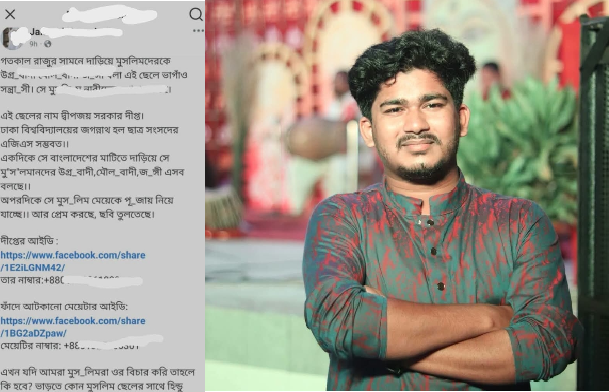
Regardless of the specific motivations of those involved, it is now clear that public advocacy is increasingly being met not with debate but with intimidation. The battleground was shifting from public argument to personal targeting.
Meanwhile, local Hindu organisations and minority-focused media outlets continued to accuse the BNP Government of failing to take visible and decisive action to contain the escalating tensions. Critics argued that the state’s response was characterised by passivity at a moment that demanded clarity and intervention. Particularly troubling were allegations that repeated requests for enhanced security at the temple complex went unanswered even as threats intensified. Whether these allegations ultimately withstand scrutiny or not, their widespread circulation among minority communities reflects a growing crisis of confidence in the state’s willingness or ability to guarantee equal protection.
The controversy surrounding the Shri Ram Murti has exposed more than the vulnerability of Bangladesh’s Hindu minority. It has exposed the silence of many of those who claim to speak in its defence.
Over the past year, major international human-rights organisations, advocacy networks and influential media institutions have demonstrated a remarkable willingness to comment on developments in Bangladesh when those developments aligned with broader political and geopolitical narratives. Yet as reports of anti-Hindu violence, intimidation, attacks on religious institutions, sexual violence and organised hate campaigns continued to emerge under the newly elected B.N.P. Government, the international response became noticeably quieter.
The contrast is impossible to ignore.
During periods of heightened political tension between India and the Yunus administration, the condition of Bangladesh’s Hindus became a subject of extensive international discussion. Statements were issued. Editorials were published. Television debates were organised. The treatment of religious minorities was repeatedly presented as evidence of a deeper crisis unfolding within Bangladesh.
Today, despite continuing reports of attacks against Hindus, hundreds of documented incidents involving religious minorities and the nationwide mobilisation triggered by the Shri Ram Murti controversy, much of that attention appears to have vanished.
This silence raises uncomfortable questions. If attacks against a minority community attract concern only when they fit prevailing political narratives, then minority rights risk becoming selective rather than universal. The credibility of human-rights advocacy rests not on defending popular victims, but on defending overlooked ones.
The same pattern is visible within India.
Only months ago, the protection of Bangladesh’s Hindus occupied a prominent place in political speeches, television debates and public discussion. Yet the protests that followed the Shri Ram Murti controversy and the growing insecurity expressed by Bangladeshi Hindu communities have received only limited attention. Outside a handful of regional outlets in West Bengal and Tripura, minority-focused publications and a small number of independent Hindu platforms, sustained coverage has been strikingly scarce. Many of the images and videos documenting recent developments have circulated primarily through X, community networks and occasional regional reporting rather than major national media channels.
Equally striking has been the silence of organised activism.
What unfolded across Bangladesh in June 2026 was one of the most significant Hindu-led mobilisations in recent memory. Students marched. Community leaders spoke out. Ordinary citizens organised demonstrations and public assemblies. Activists filed police complaints despite threats, intimidation and online harassment.
In Bangladesh, members of a vulnerable minority community took to the streets despite genuine personal risks. Across the border, many organisations possessing far greater resources, influence and freedom of action largely remain spectators.
This absence is particularly difficult to understand in West Bengal. Bound to Bangladesh by geography, history and memory, it is perhaps the place where developments affecting Bangladesh’s Hindu minority might most naturally have been expected to provoke large-scale mobilisation. Instead, the response was characterised largely by silence.
The most common explanation is political reality. Many Hindu organisations operate within political ecosystems and are influenced, directly or indirectly, by the positions of parties and governments with which they are broadly aligned. Criticising opponents is easy. Applying the same standards to allies is considerably harder.
Yet if this explanation is correct, it is not a defence of the silence but an indictment of it.
For if concern for persecuted Hindus depends upon who occupies political office, then the cause has already ceased to be civilisational and become political.
The test of principle is not whether one speaks when doing so is easy. The test is whether one speaks when doing so is inconvenient. If organisations are willing to mobilise only when doing so carries no political cost, then they are not defending a principle. They are responding to a political opportunity.
Civilisational causes derive their moral authority from consistency. The moment the defence of persecuted Hindus becomes contingent upon political convenience, that authority begins to erode. Supporters learn that some victims deserve mobilisation while others deserve silence. Vulnerable communities learn that their security may depend less on principle than on political calculation.
That is why the current silence matters.
The question is not whether Bangladesh’s Hindus are suffering. The documented incidents, the protests and the testimony of victims have already answered that question.
The real question is whether those who once demanded that the world listen have quietly stopped listening themselves.
For a vulnerable minority confronting intimidation, violence and uncertainty, silence from adversaries is expected.
Silence from those who once claimed to stand beside them is far harder to explain.
If you love our work, you can help us by contributing a small amount of your choice. It’ll help us to continue.