What TV doesn't, print can't; we deliver.
What TV doesn't, print can't; we deliver.
What TV doesn't, print can't; we deliver.

Markets for military-grade weapons has moved beyond jungles, border trails and hidden depots into the digital realm in the Kuki-dominated districts of Manipur, where it is becoming disturbingly accessible.
At the center of these allegations is a WhatsApp group brazenly titled “THAL ORDER”. According to sources familiar with its activity, the group functions less like a covert network and more like an open bazaar, where assault rifles and other sophisticated weapons are discussed, priced and scheduled for delivery with unsettling normalcy. Transactions are negotiated in plain language. Delivery locations and timelines are coordinated. Participants are said to operate with a confidence that suggests assurance instead of secrecy.
The group is reportedly administered by individuals identified as L. Seiminchung Khongsai and Lengougin Khongsai, with several other individuals like Mangminglal Hangshing, Sei David Haokip and Paominson Kipgen acting prominent participants.
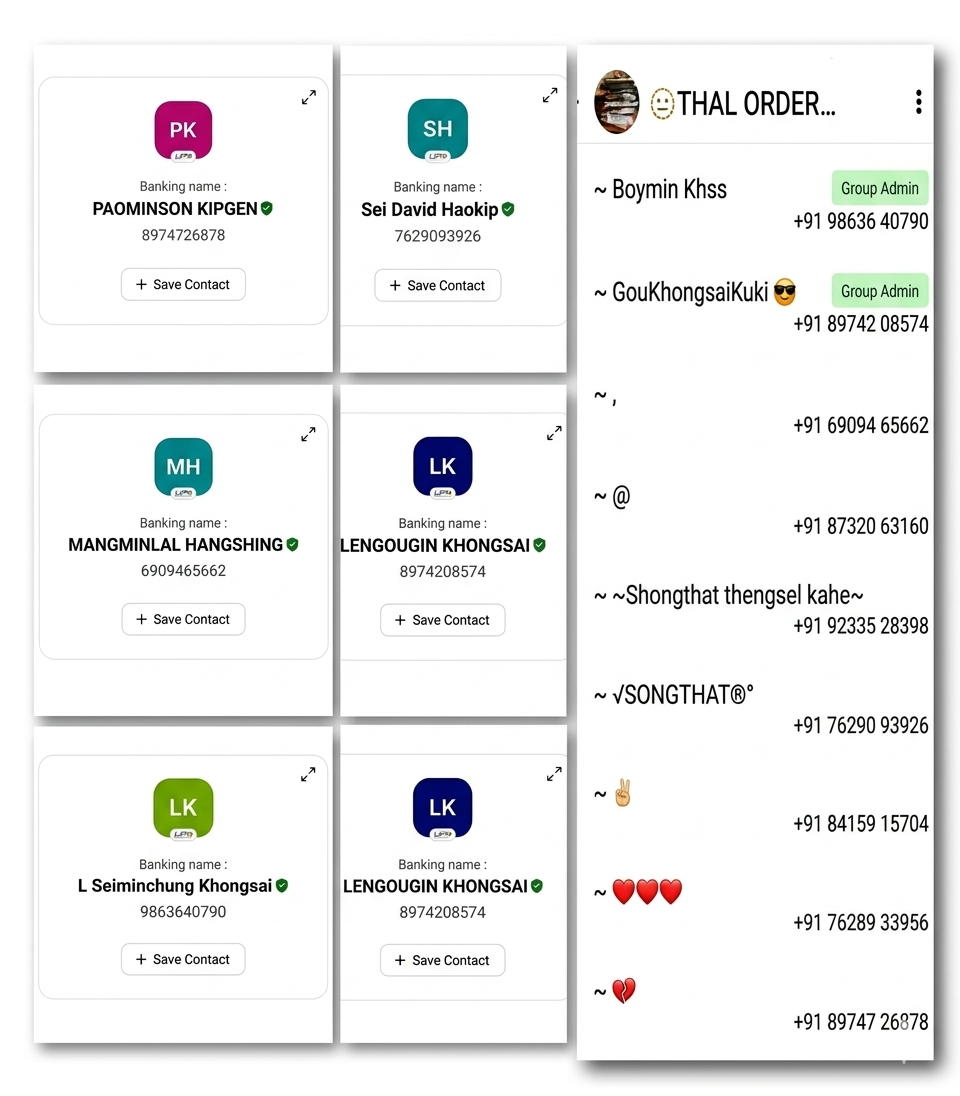
Most sophisticated military-grade weapons entering Manipur are traced back to Myanmar, sourced through a fragmented and informal ecosystem. At its core are :
The India–Myanmar border remains one of South Asia’s most active illicit arms routes, intertwined with narcotics networks and insurgent financing. Weapons originating from Southeast Asian black markets, Myanmar civil war stockpiles and Chinese-origin or global surplus stocks move through the Sagaing region or Chin State before entering India through the porous frontiers of Manipur or Mizoram.
Insurgent groups operating along the Indo–Myanmar border function as quasi-contractors, with cadres facilitating cross-border movement and border-adjacent camps doubling as storage hubs.
A further layer is added by foreign mercenaries and weapons specialists. Individuals such as Daniel Stephen Courney are alleged to have supplied drones and protective gear during the peak of the 2023–25 violence in Manipur , while Matthew VanDyke, along with six Ukrainian operatives, was arrested for allegedly supplying weapons and facilitating drone technology transfers to insurgents in Myanmar.
Ground-level documentation by activists like Vladimir Adityanaath, has also pointed to the presence of Eastern European combat veterans and drone specialists training anti-junta forces in FPV kamikaze drone operations, improvised aerial payloads and sniping techniques in Chin State near the Mizoram border. Camp Victoria, located across the Tiau river near Champhai, has emerged as one such reported training site.

Despite heightened surveillance, key corridors along the India–Myanmar frontier continue to facilitate the movement of arms into Manipur. The Moreh–Tamu axis endures as a primary crossing point, while the well-established timber smuggling routes along the forested and remote regions of Chandel District have evolved into established transit routes.
In the villages surrounding Moreh, including Haolenphai, Minou, Molcham, Yoldam, Sahei and Lianphai, decades of cross-border migration have reshaped local demographics in ways that facilitate logistics and distribution networks.
Further west, the remote Behiang sector linking Churachandpur with Myanmar’s Chin State has emerged as another critical corridor. Informal movement of migrants and illicit trafficking frequently intersect with refuge seekers, migrants and smugglers relying on the same shared routes and temporary settlements that complicate sustained monitoring and enforcement.

Beyond Manipur, the Mizoram sector , particularly the Champhai axis, represents a quieter yet strategically significant channel. Directly connected to Chin State, crossing points such as Zokhawthar, the Hnahlan belt and villages along the Tiau River leverage riverine terrain to enable discreet, small-scale consignments.
Further south, the sparsely populated Lawngtlai belt opens into deeper stretches of the Myanmar frontier, supporting longer and better-concealed trafficking routes through dense and difficult terrain.
Law enforcement in the Kuki-dominated districts of Manipur presents a markedly different picture from that of the Imphal Valley. In districts such as Kangpokpi and Churachandpur, a series of incidents has underscored the limits of state authority.
Internal advisories cautioning police personnel against engaging with or yielding to extortion demands by armed groups had to be issued more than once in Kangpokpi District.
Disciplinary action by Superintendent of Police Shivanand Surve against constable Siamlal Paul, for alleged links with armed “village volunteers,” was followed by violent unrest, with a mob setting fire to government property and targeting administrative infrastructure in ChuraChandpur.
This divergence, however, is not solely a question of intent but of constraint. The hill districts are forested, dispersed and difficult to dominate physically, unlike the densely populated Imphal Valley where state presence is more continuous and enforcement more immediate.
Armed actors in these regions often operate within community structures with public support, blurring the line between militant networks and locally perceived “defence groups”. Deep-seated social embedding raises the stakes of enforcement, transforming routine arrests or disarmament into potential flashpoints for mass unrest.
Compounding this are operational limitations. Locally recruited police forces navigate complex community pressures, while central forces operate under restrictive rules of engagement, often prioritizing containment over confrontation. The result is a pattern of selective, risk-managed enforcement that is more assertive in the Imphal Valley, but more cautious in ChuraChandpur or Kangpokpi.
For residents of the Imphal Valley, where enforcement remains visibly stricter and economic life is frequently disrupted by blockades, this asymmetry has fostered a deepening perception of unequal application of the law. Whether rooted in structural constraints or administrative caution, the outcome is a fragmented enforcement landscape that keeps eroding public trust and the principle of uniform state authority.
The trajectory is unmistakable. What begins as a WhatsApp conversation in the hills of Manipur now connects seamlessly to cross-border supply chains, insurgent logistics and a fractured enforcement regime on the ground. When weapons move this easily and law responds this unevenly, the question is about the integrity of the system itself.
A state cannot afford parallel realities of enforcement within its own borders. If digital shadow markets continue to intersect with porous frontiers and selective control, the consequences will not remain confined to Kangpokpi or Churachandpur. They will redefine the contours of security, governance and trust across Manipur.
Restoring order, therefore, is not simply about intercepting weapons. It is about restoring uniformity of law, without which the authority of the state risks becoming negotiable.