What TV doesn't, print can't; we deliver.
What TV doesn't, print can't; we deliver.
What TV doesn't, print can't; we deliver.

The latest violence directed against ethnic Assamese and Bengali residents and workers in Shillong on 19 August, following a rally organised by the Khasi Students’ Union (KSU), marks another grave episode in Meghalaya’s long-running cycle of ethnic targeting. At least 31 vehicles, predominantly driven by persons from Assam, were vandalised, while Bengali and Assamese residents were subjected to stone-pelting and physical assault. The violence also extended to the targeted vandalisation of sculptures and idols commemorating national icons Netaji Subhas Chandra Bose and Swami Vivekananda.
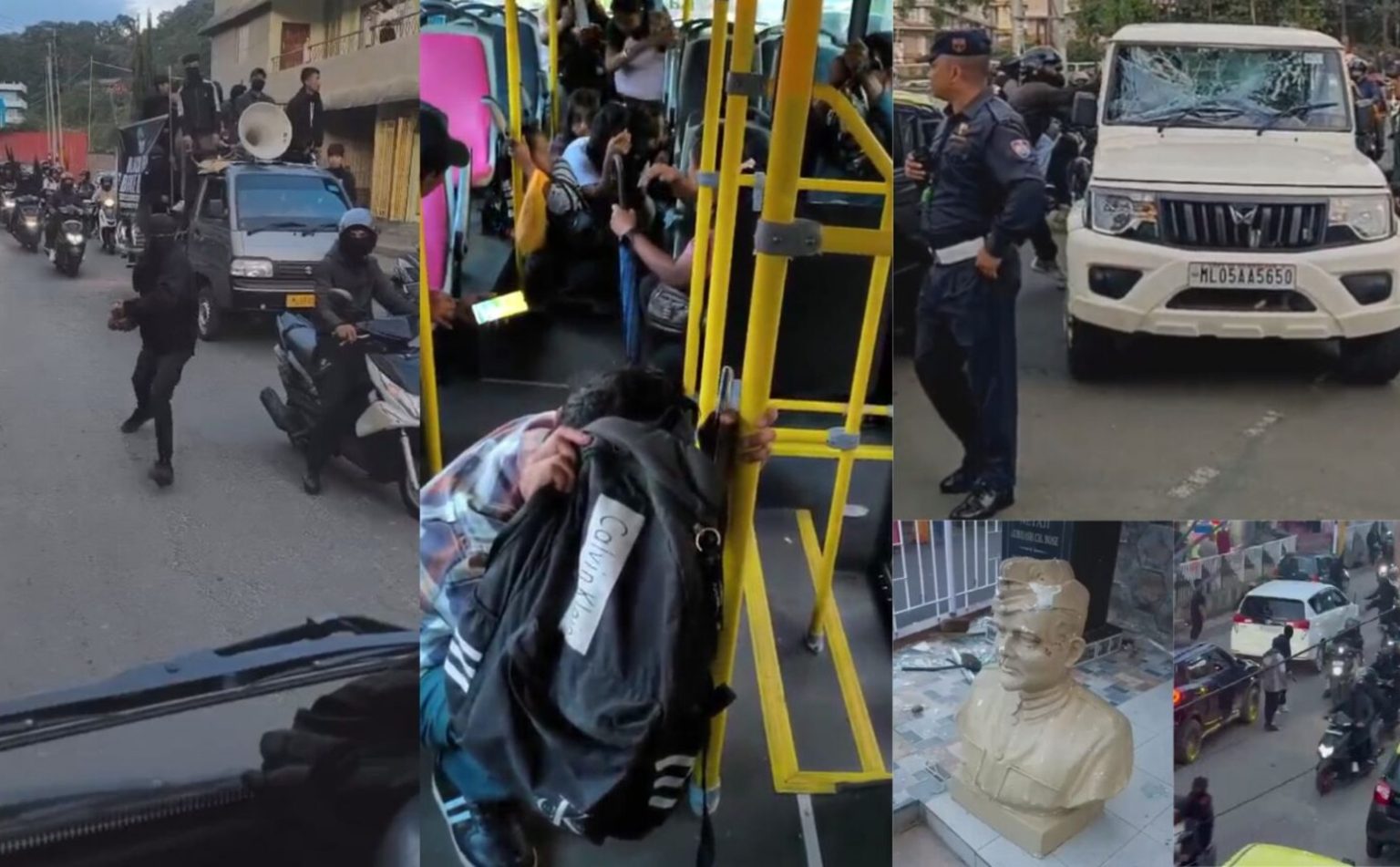

The attacks have generated widespread discussion regarding both the conduct of the perpetrators and the response of the administration. Sections of the media have reported the deep frustration and sense of abandonment among Bengali Hindu residents of RR Colony, who have accused political leaders of approaching the Bengali community for votes during elections while failing to provide basic security and dignity of life when members of the community are systematically targeted. Yet the violence did not end on 19 August. Attacks on vehicles bearing Assamese registration numbers continued on 20 and 21 August, receiving considerably less attention from the mainstream media.
The subsequent police action has itself become a matter of controversy. The arrests of KSU president Raymond Kharjana, general secretary Reuben Najiar and vice-president Pynkmenlang Sanmiet, along with police action against the organisation’s Shillong office, has been viewed by a significant section of local residents as unnecessary and excessive. More importantly, these arrests and police measures did not bring the violence to an end.
The violence against fellow Indian citizens in Meghalaya since 19 August cannot be understood as an isolated disturbance. It is the product of a much deeper political and social environment in which colonial-era terminology, rigid ethnic categorisation, identity politics and competition over reservation and state resources have been allowed to reinforce one another. The KSUs has been involved in 13 documented instances of riots, vandalism, arson, stone pelting and hooliganism since 1978.
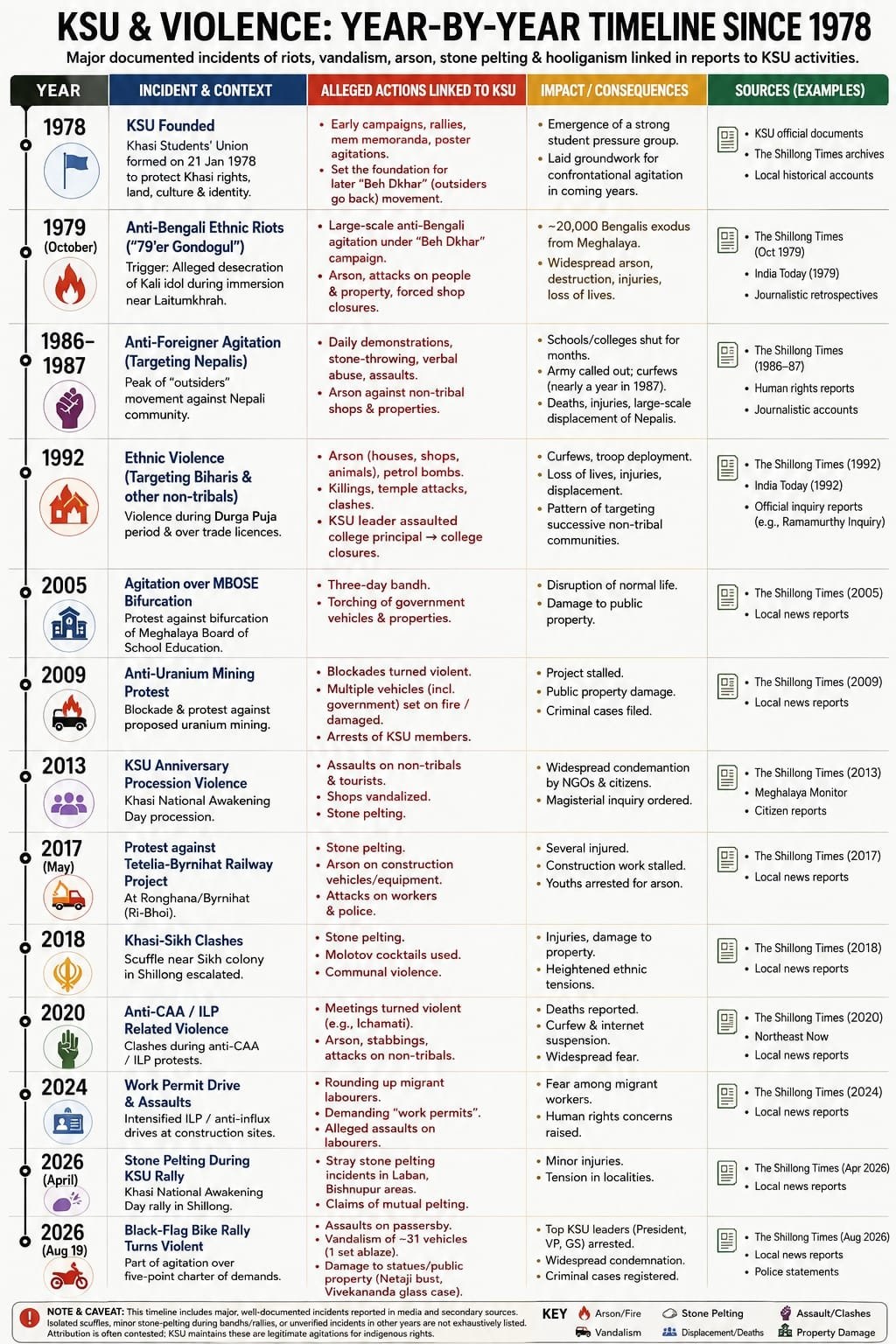
At the centre of this environment is the continued use of the term “Dkhar” as a racialised and xenophobic label for people regarded as outsiders or foreigners. What began as a mechanism of social exclusion has, over decades, become embedded within political mobilisation and popular rhetoric. Since 1979, successive waves of violence directed at so-called “Dhkars” have resulted in killings, displacement and the uprooting of tens of thousands of residents. The cumulative human cost has been immense, with at least 65,000 Hindu residents reported killed or displaced over the course of these conflicts.
The religious dimension of this conflict also requires serious examination. Christian missionary and church networks, particularly sections associated with Evangelical and Baptist institutions, have played a powerful role in shaping the political and cultural environment of the state. Missionaries have exploited the insecurities of the janajatis, urging them to redirect their frustrations towards communities designated as outsiders.
One of the most striking observations from repeated visits to Meghalaya is the deep cultural fracture between Seng Khasi and other indigenous communities that have retained their traditional faith and practices and sections of Khasi, Garo and Jaintia society that converted to Christianity. The extent of this rupture becomes particularly visible during the annual Seng Kut Snem festival, when Seng Khasi communities gather at traditional sites and water bodies such as Umiam Lake to honour their ancestors and preserve their indigenous religious traditions. The fact that communities of common ethnic origin can increasingly regard one another as culturally alien is one of the most disturbing consequences of this transformation. Meghalaya has a highly protective reservation structure, with approximately 85% of government employment opportunities reserved for communities covered by Scheduled Tribe and Scheduled Caste provisions. Yet reservation and political protection have not prevented repeated violence against people classified as outsiders. The overwhelming majority of victims of these episodes have been Hindus, including both Indian citizens and displaced victims of Islamist-led pogroms in Bangladesh.
The Church has managed to embed itself deeply within local politics, while its utility as a geopolitical instrument for nations such as the United States has ensured a steady flow of foreign funding. This convergence of religious bigotry, identity-driven politics and foreign geopolitical influence has helped create an environment in which ethnic exclusion can be institutionalised, hostility towards ‘outsiders’ normalised, and violence against fellow Indian citizens repeatedly justified, enabled or ignored.
The narrative that Bengali and Assamese people are “outsiders” in Meghalaya, or that Hinduism itself is an alien or foreign religion to the region, collapses under even a basic examination of Meghalaya’s history, archaeology and cultural traditions. The historical record demonstrates that the religious, cultural and political connections between the Khasi, Jaintia and Garo hills and the wider Hindu civilisation of eastern India are centuries old. The presence of Hindu traditions in Meghalaya is not an intrusion into the region’s history; it is part of that history.
The presence of Hinduism in Meghalaya can be traced to the ancient period. The Tantra Churamani identifies Nartiang in present-day Meghalaya as a Shakti Peetha, associated with the place where the left thigh of Devi Sati is believed to have fallen. The deity continues to be worshipped as Maa Jainteshwari in the Mynthidu, Jowai and Nartiang region.
What makes this history particularly significant is that the religious traditions of the region did not simply reproduce practices from elsewhere. Over centuries, Shakta traditions interacted and fused with indigenous customs and local practices, producing a distinctive religious culture rooted in the landscape itself.
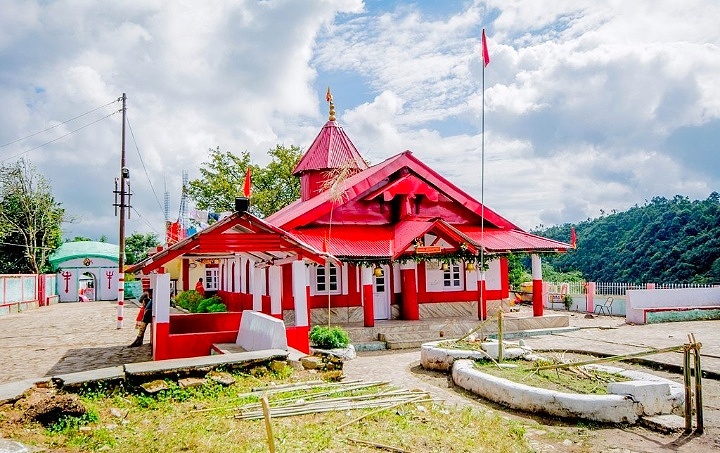
The sacred character attributed to forests and natural sites in Meghalaya also reflects this interaction between indigenous traditions and Hindu religious practices. The forests around Nartiang and Jowai contain sites regarded as sacred by local communities like the Labasa or Leopard God forest at Mawphlang.
The historical presence of Assamese Hindus in the region can likewise be traced back many centuries. Evidence from the Jaintia kingdom and the wider Jaintia ranges places Assamese cultural and religious influence in the region as early as approximately 600 AD. According to historical traditions concerning the Jaintia rulers, King Guhak developed a strong interest in Hindu Dharma and invited Brahmins from Kamrup in present-day Assam to his kingdom. Stone images representing Kans Vadh, Griva Kali and Jangha Kali were installed and pratistha ceremonies were performed at hilltop sites. To describe Assamese people as recent “outsiders” in Meghalaya is to impose a modern ethnic and territorial framework upon a historical landscape in which political, cultural, religious and economic boundaries were considerably more fluid.
The historical presence of Bengalis in the region is likewise centuries old and cannot be reduced to colonial era migration. By approximately 1500 AD, the Jaintia kingdom had emerged as a substantial and prosperous political power encompassing large parts of present-day Meghalaya as well as extensive territories in what is now the Srihatta region of Bangladesh. Its territory covered approximately 3,850 square miles (9,972 square kilometres) and extended from the Brahmaputra basin in the north towards the Surma valley in the south.
The kingdom’s economic strength was considerable. It produced and traded silk, cotton and muslin, iron, weapons, muskets, hand cannons, gunpowder, elephants, ivory, rice, dried fish, sugar, oranges, areca nuts and betel leaves. The Jaintia rulers maintained their own currency, including gold and silver coinage, demonstrating the sophistication and autonomy of the kingdom.
Crucially, the administration of this kingdom was not culturally or linguistically isolated from the plains. Bengali, Assamese and Sanskrit were used in the kingdom’s official and administrative life. Bengali and Assamese scribes played important roles in the royal bureaucracy, including revenue collection, taxation, legal documentation and the administration of markets in the foothills.
Land grants, administrative records and inscriptions associated with the kingdom were extensively recorded in Bengali, while Bengali and Assamese Brahmins were invited to serve as royal priests, advisers and custodians of state temples, including the renowned Nartiang Durga Temple.
The majority of the Jaintia Kingdom’s total population was actually Bengali. While the political power and the summer capital (Nartiang) remained in the hills of Meghalaya, the winter capital Jaintiapur was located in the vast fertile plains of the Jaintia Pargana in Jaintiapur.
Archaeological remains in the wider Meghalaya–Assam region demonstrate the antiquity of Hindu religious practices associated with the cultural world of eastern India. The Bhaitbari fortified settlement, associated with the ancient Pragjyotisha-Kamarupa civilisation, contains an extraordinary collection of temple remains and sculptures. The complex includes temples and religious structures associated with deities such as Ganesha, Parvati, Durga, Saraswati, Kali and Kubera, alongside an octagonal temple dedicated to Mahadev.

The Syndai Temple Complex, with its notable Ganesha sculpture and Mahadev temple and the Mahadev Khola Dham in the hills of Laban in Shillong, further demonstrate the longstanding presence of Hindu sacred architecture and artistic traditions in the region that predate the arrival of the British by several centuries.
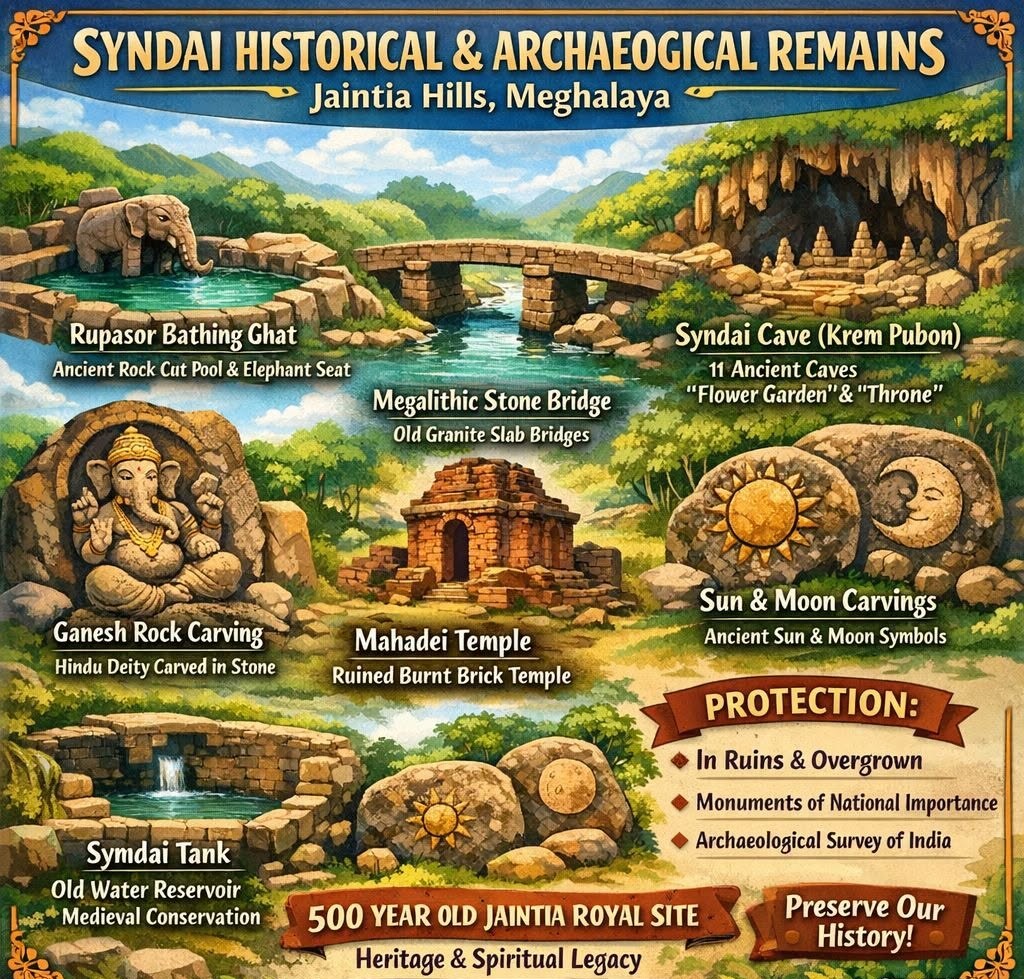
Therefore, labelling Bengalis or Assamese Hindus as “Dhkars” and treating them as foreign interlopers is not merely historically inaccurate, but also politically constructed narrative designed to deliberately erase the region’s interconnected past.
The creation of Meghalaya as a separate state in 1972 was driven by a legitimate and historically understandable objective of protecting the language, culture, land, employment opportunities and political representation of the Garo, Khasi and Jaintia tribes. The fundamental purpose of that project was therefore cultural preservation and political empowerment.
The failure lay not in the recognition of indigenous interests, but in the architecture through which those interests were protected. Meghalaya’s new political order was constructed overwhelmingly around ethnic identity, while almost no attention was given to building an inclusive economic and civic framework for the Bengali, Assamese, Gorkha and other families who had already made the region their home. The state was given extensive protections, reservations, grants and constitutional privileges, but without a robust economic model capable of converting those protections into sustainable prosperity.
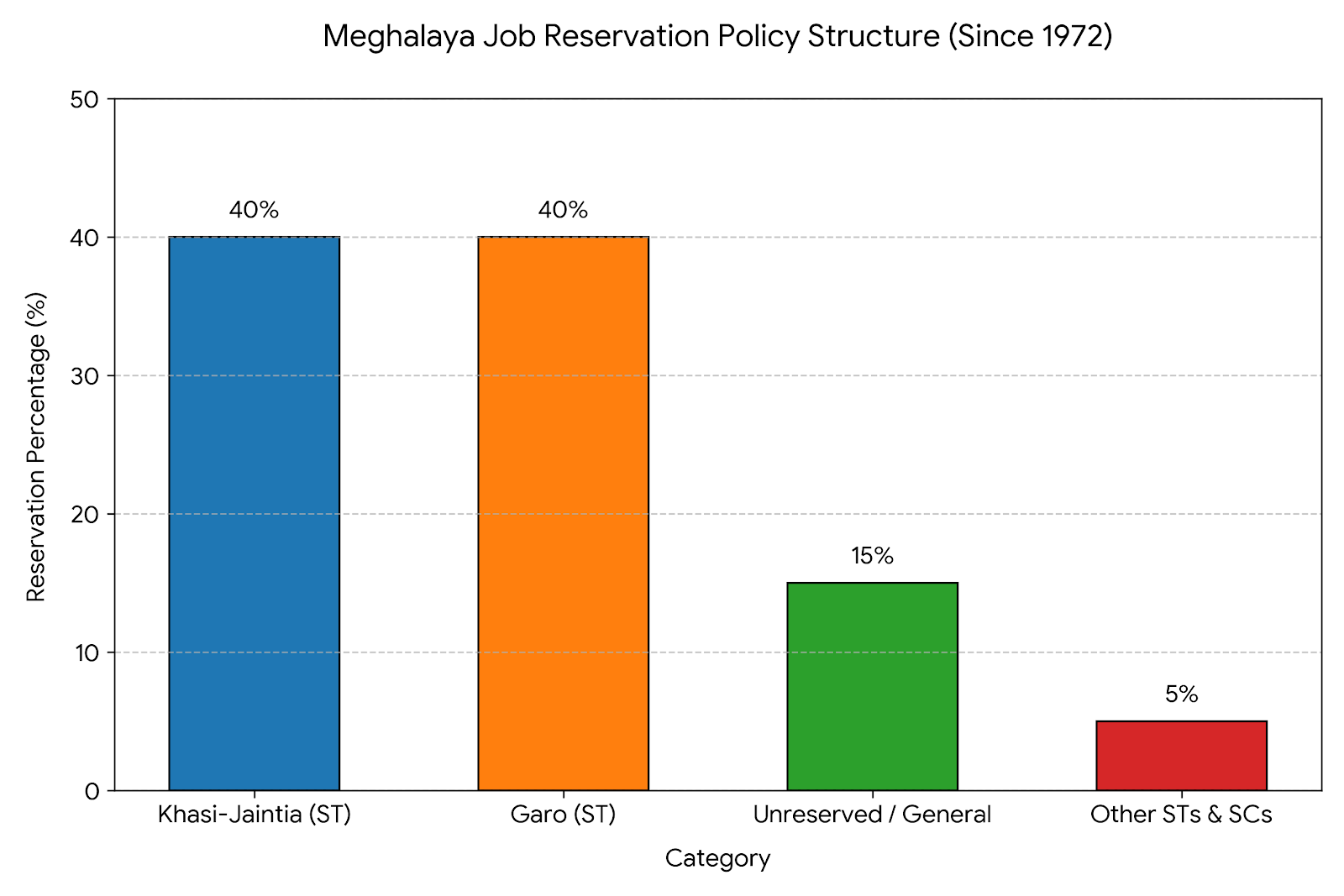
Extensive reservation, grants and other forms of preferential state support became central features of Meghalaya’s political economy. These measures were intended to compensate for historical disadvantage and protect indigenous communities from demographic and economic marginalisation. But protection without parallel investment in productivity, industrialisation, educational diversity, private enterprise and employment creation created a structural imbalance.
The state increasingly became dependent upon government employment, transfers, grants and politically mediated benefits, rather than generating sufficient economic opportunity through a broad productive base. The result was a dangerous transformation, where measures originally intended as safeguards are now being perceived as permanent entitlements.
The problem was compounded by restrictions concerning land ownership and transfer, extensive reservation in public employment and the discretionary application of special constitutional arrangements. The blanket imposition of the 6th schedule in 10 out of the 11 districts of Meghalaya along strict ethnic lines had ensured that even Bengali and Assamese Hindu families living in Meghalaya since the pre-colonial era were denied the rights to freely open or expand businesses and purchase properties. In Meghalaya, local traditional neighborhood councils (called Dorbar Shnong in Khasi areas and managed by a headman or Rangbah Shnong) hold immense social control. Although they are traditional bodies rather than constitutional courts, a non-tribal resident frequently requires a “No Objection Certificate” (NOC) or character certificate from the local headman to apply for a passport, open a bank account, install an electricity connection, or rent commercial property.
A reservation system can distribute existing opportunities, but it is not a substitute for the creation of new opportunities. Grants can finance institutions, but they cannot permanently replace productivity. Constitutional safeguards can prevent exploitation, but they cannot create prosperity by themselves.
When benefits expand without a corresponding expansion of economic responsibility and productive capacity, political competition inevitably shifts from creating wealth to controlling access to benefits.
And once access to benefits becomes associated with ethnic identity, identity politics becomes economically rational.
The contradiction becomes even sharper when culture is examined.
Meghalaya was created partly to preserve indigenous traditions, languages and institutions. Yet the state did not simultaneously construct a sufficiently strong network of indigenous and non-Christian educational and cultural institutions capable of competing with the rapidly expanding church-backed institutional system. Organisations such as the Ramakrishna Mission, Seng Khasi and Brahmo educational centres were largely private initiatives. The state sought to preserve indigenous culture while allowing the institutions through which successive generations were educated and socially organised to become increasingly detached from that culture.
Conversion was therefore not merely a matter of personal religious belief. Where church institutions became dominant providers of education, scholarships, social assistance and employment networks, religious affiliation have also become connected to access to opportunity. The frequent complaints of non-Christian students regarding discrimination in higher education opportunities on religious grounds or patients being aggressively coerced to convert while undergoing treatment in hospitals are well documented.
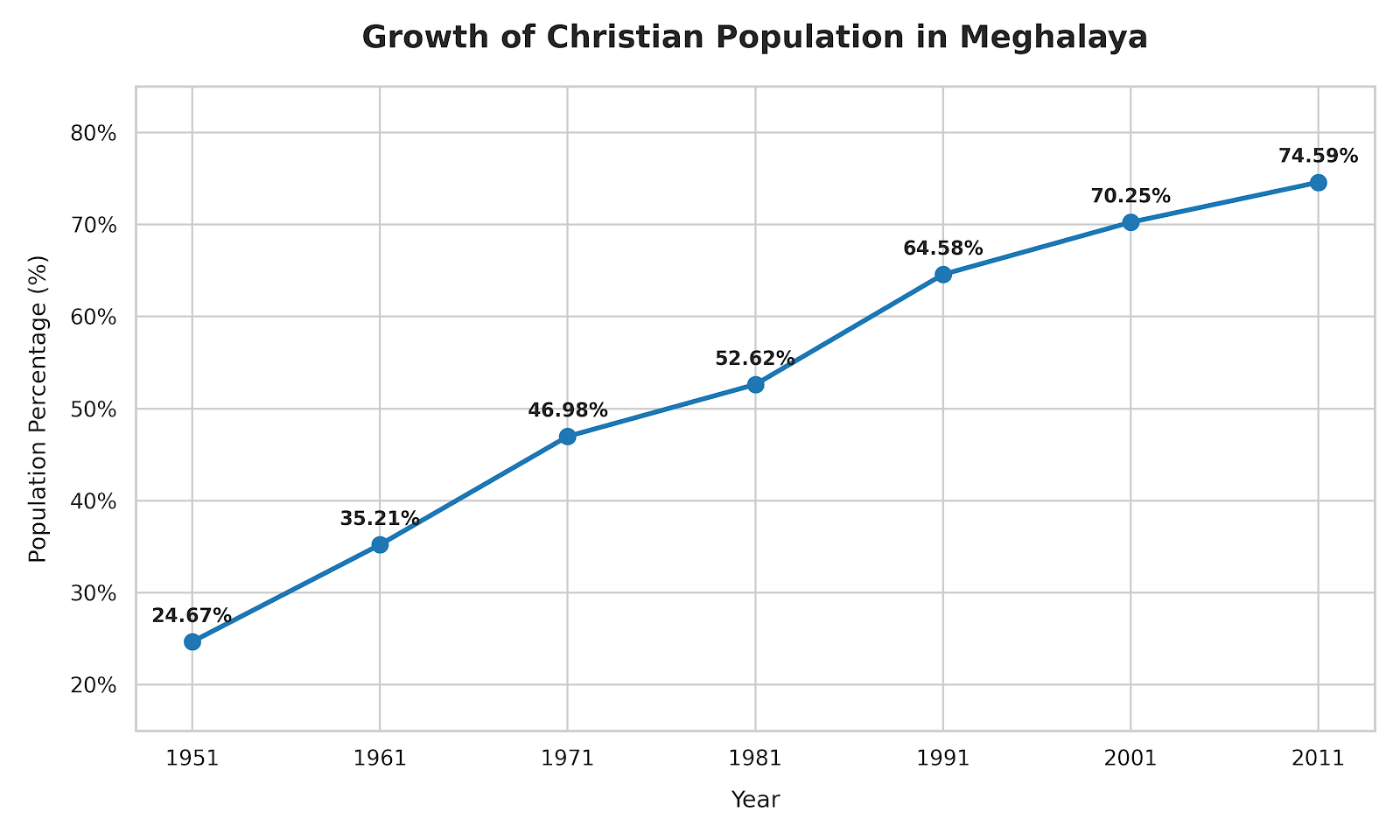
With its extensive educational, social and political networks and access to substantial external resources, Christian institutions acquired an influence extending far beyond religious practice.
The political influence of the Church is not merely theoretical. During the 2022 Meghalaya Assembly elections, Shillong Archbishop Dominic Jala publicly issued a set of electoral “ten commandments”, urging voters to support candidates according to specified political and social criteria. This is just one of the many documented instances of the extraordinary degree to which a major religious institution could intervene directly in electoral discourse and attempt to shape political behaviour. Whenever one institution becomes simultaneously a major provider of education, social assistance, cultural identity and political mobilisation, it acquires enormous capacity to shape the political preferences of the population dependent upon it.
Once ethnicity became the principal basis for political protection, economic benefits, land rights and political representation, the distinction between protecting a community and privileging an identity became increasingly blurred.
Bengali, Assamese and Gorkha residents could be represented as threats to employment. Their businesses could be portrayed as threats to indigenous economic interests. Their presence could be framed as demographic encroachment. And the term “Dkhar” could transform from a description of perceived foreignness into a political instrument for social exclusion. A system that continuously tells one section of society that its security and prosperity depend upon maintaining ethnic boundaries inevitably produced political actors whose influence depends upon keeping those boundaries alive.
This model has failed on all three of the objectives that should matter most to the Indian state: national security, prosperity and cultural preservation.
It has not produced adequate economic integration. It has not eliminated social conflict. It has not created an inclusive civic identity capable of absorbing different communities into a common national framework. And, most importantly, the indigenous cultural traditions that the state was created to protect have themselves faced increasing institutional displacement.
Identity-based policymaking, particularly when constructed through a colonial administrative lens that classifies communities into rigid categories such as “Scheduled Tribes” and “outsiders”, cannot provide a durable foundation for a modern nation-state. Colonial classifications were designed to categorise populations for administrative purposes and should not become permanent political identities through which citizenship, opportunity and belonging are measured.
A policy framework that divides citizens primarily according to inherited identity cannot simultaneously build national integration, maximise economic productivity and preserve indigenous culture.
Organised religion with political objectives and a deeply rooted international institutional network can exploit existing ethnic fault lines with extraordinary effectiveness. In Meghalaya, the decisive struggle was over who would control education, culture, social institutions and ultimately the definition of identity itself.
From the earliest expansion of the Christian missionary enterprise, indigenous Khasi and Jaintia religious traditions were frequently portrayed as primitive, superstitious or associated with evil and “Satan.” Missionary education and Westernised curricula consequently became instruments not merely of literacy, but of cultural deracination.
Yet indigenous society did not surrender passively. Bengali Hindu families who arrived in Shillong during British rule established schools, libraries and women’s organisations that provided education without requiring conversion. The Mohila Shomiti, founded in 1874, became a pioneering institution for women’s education, healthcare and social reform, by 1888 it was operating schools in Shillong. Bengali intellectuals and traders also contributed substantially to the educational and institutional foundations that later strengthened the Seng Khasi movement.
The formation of Seng Khasi in 1899 represented a direct indigenous response to missionary cultural dominance. Its objectives of religious solidarity, tribal solidarity and attachment to the native land were inseparable from the preservation of indigenous identity. Bengali Hindus provided intellectual, educational and financial support, creating a remarkable example of cultural cooperation between indigenous Khasi society and the wider Hindu intellectual world.
After Independence, however, this indigenous institutional ecosystem received little meaningful support from the Indian state. The imbalance became progressively more severe and pressure to convert through education, scholarships, healthcare and social services, alongside discrimination and intimidation directed at non-Christians became everyday realities.
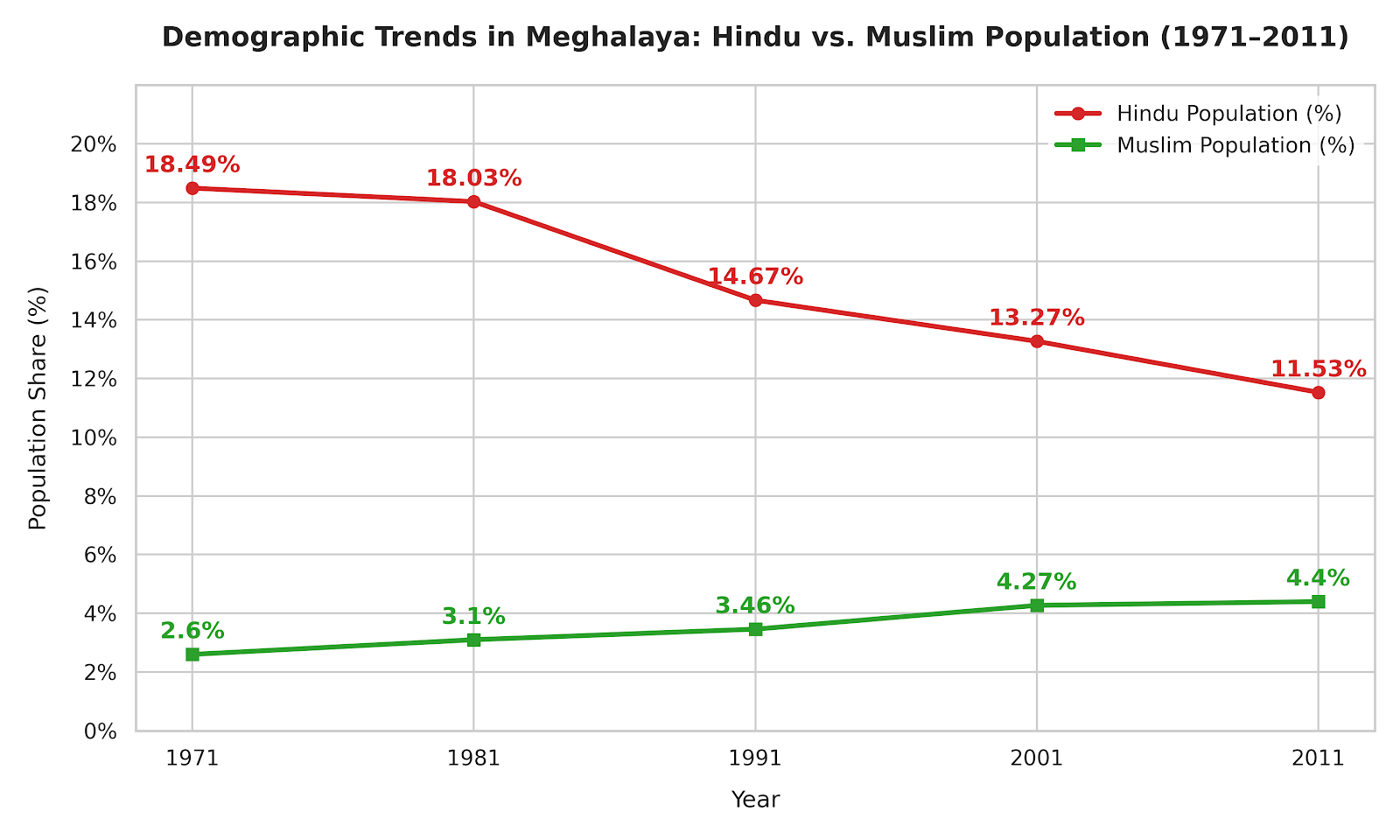
The demographic record makes the question impossible to dismiss as a series of isolated incidents. The Hindu share of Meghalaya’s population fell from 18.49% in 1971 to 11.53% in 2011, while the Muslim share rose steadily from 2.6% to 4.395% over the same period. During the December 2020 anti-CAA protests in Shillong, which the source characterises as having become a platform for anti-Hindu rhetoric, members of the Muslim community also participated alongside the KSU-led demonstrations. A glass-fronted mosque, Madina Masjid, was subsequently established in the Laban area of Shillong, in close proximity to the Army Garrison Ground. Salahuddin Ahmed, a close associate of former Bangladeshi Prime Minister Khaleda Zia and described to be well-connected Pakistan’s ISI was arrested while undergoing treatment in 2015, creating an international controversy.

Demographic change alone cannot establish causation. But when examined alongside decades of documented violence, displacement, institutional exclusion and pressure directed at non-Christian communities, it demands serious scrutiny. The “protection of indigenous identity” cannot be accepted uncritically as an explanation for recurring violence when the communities most visibly losing demographic and institutional ground are almost exclusively non-Christian. What presents itself as spontaneous ethnic resistance is a sustained system of social exclusion in which religion, ethnicity, institutional power and political mobilisation reinforce one another. The destruction of indigenous culture and the targeting of non-Christian communities are not separate phenomena. They are two sides of the same institutional failure.
The Khasi Students’ Union (KSU), established on 20 March 1978, had already emerged as a major force in the politics of “outsider” exclusion. The organisation would subsequently become associated with 13 documented instances riots and attacks against non-tribal communities. Former Meghalaya Governor Tathagata Roy later called for the organisation to be banned, describing it as an “anti-national terrorist organisation.”
The violence that erupted in Shillong in October 1979, a sustained campaign of mass killing, arson, rape, looting, intimidation and forced displacement directed primarily against Hindus perceived as “outsiders.”
What began with the desecration of the Kali Mata idol at Lal Villa on 22 October 1979 rapidly escalated into one of the darkest episodes in Meghalaya’s post-independence history.
The scale of the brutality is captured in the recollections of author and professor Nabanipa Bhattacharjee, who records a series of individual tragedies that illustrate the ferocity of the attacks. Partha Adhyapak was stabbed to death. Ratish Ghosh, a sweet vendor, was thrown into a cauldron of boiling syrup and burned alive. Bimal Shyam Purkayastha was struck by an arrow during a peace procession and permanently lost his eyesight. The son of Dr. Sisir Roy was murdered while returning from school.
The violence extended even to passengers travelling through the state. A State Transport bus travelling from Dawki to Shillong was stopped at Laitlyngkot, where eight Hindu passengers were forced to disembark and beaten to death with stones.
The violence continued for almost two months with near non-existent state intervention. From 22nd October till late December 1979, Hindu families were subjected to sustained attacks, while thousands were driven from their homes. Armed mobs of thousands attacked Hindu neighbourhoods, dragging residents from their homes and setting them on fire. Elsewhere, people were stabbed and beaten to death, while scores more were seriously injured. Only after the Army assumed control did the situation begin to return gradually towards normalcy.
Approximately 20,000 Hindus were displaced from Meghalaya and many were forced into refugee camps under appalling conditions. Their plight was compounded by the simultaneous Bongal Kheda movement in Assam, which meant that many fleeing Meghalaya could not simply return to Assam and instead remained displaced, with many eventually settling in Tripura or elsewhere.
The response of the Meghalaya government under B. B. Lyngdoh came only after the violence had escalated dramatically. Curfews and police measures were introduced, but the restrictions were repeatedly violated.
On 21 December, following further violence that left one person dead and approximately 70 injured, a shoot-at-sight order was imposed and an indefinite curfew reintroduced. The following day, after 61 days of violence, Shillong was handed over to the Army.
The violence is often retrospectively described as an anti-Bengali movement. That description is incomplete. Dozens of Assamese families who had lived for generations in neighbourhoods including Mawprem, Jaiaw and Laitumkhrah were subjected to intimidation and forced displacement. Bengali and Assamese Hindu houses in Malki were systematically burnt down to the ground.
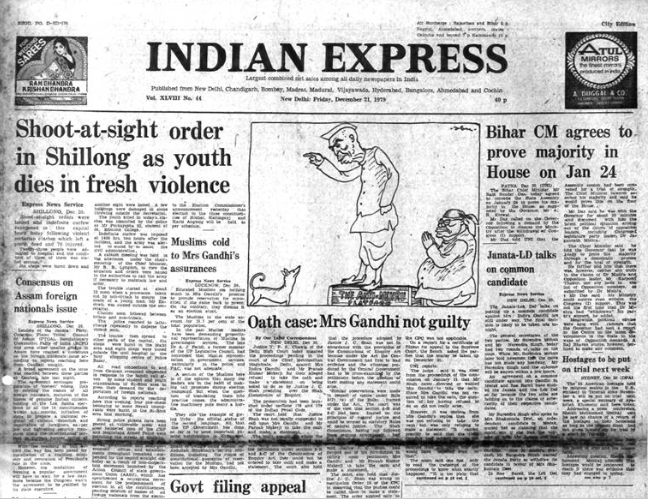
The violence is often retrospectively described as an anti-Bengali movement. That description is incomplete. Dozens of Assamese families who had lived for generations in neighbourhoods including Mawprem, Jaiaw and Laitumkhrah were subjected to intimidation and forced displacement. Bengali and Assamese Hindu houses in Malki were systematically burnt down to the ground.
Because the mobs frequently did not distinguish between different non-tribal communities, Assamese families were forced to abandon businesses, homes and ancestral property. Many fled to temporary refugee settlements or permanently relocated to Guwahati and the Brahmaputra Valley.
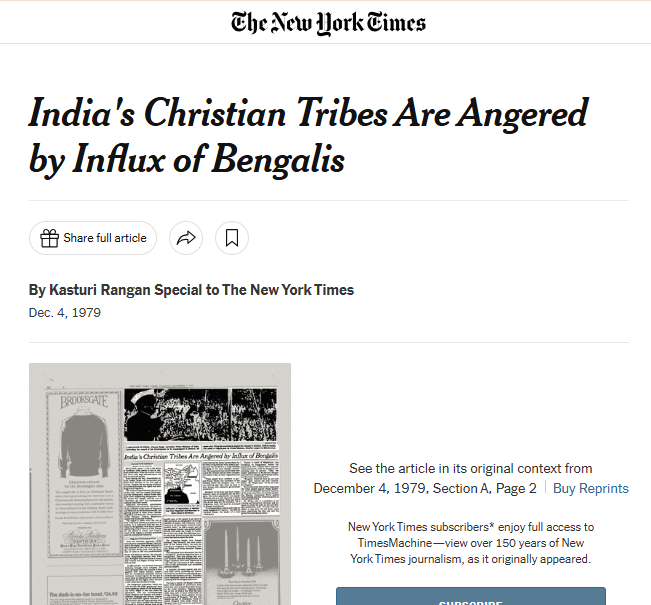
The events of 1979 established a devastating precedent of violence being used as a mechanism of political control. It established the fact that once the political definition of an “outsider” is accepted, violence, arson and demographic transformation through large-scale displacement would go unpunished. The subsequent decades cannot be understood without confronting this foundational rupture.
The second major wave of large-scale ethnic violence erupted in 1986, when the Khasi Students’ Union (KSU) launched an “anti-foreigners” agitation. On paper, the campaign was directed principally against approximately 75,000 Nepali Hindus who had lived in Meghalaya for generations and had posed no demographic or political threat to the indigenous tribal population. In practice, however, the violence rapidly expanded beyond the Nepali community to encompass Bengali, Assamese and other Hindu residents, including established businessmen and traders.
By 1987, Shillong had effectively become a city under siege. Curfews became a recurring feature of daily life, with the Army repeatedly called in to restore order. In late May, two Nepali students of Shillong College were brutally assaulted by Christian students, triggering an escalation that included forced blackouts, attacks on cinemas, systematic looting of Hindu-owned shops and widespread arson. Between 12 and 18 June, seven shops were burned, while security forces were forced to open fire to contain the violence. On 9 July, the Army was again deployed.
The streets increasingly became theatres of organised intimidation. Thousands of students defied curfew and marched towards the Secretariat carrying banners demanding that “non-tribals get out.” The rhetoric of an anti-foreigner movement had therefore evolved into something considerably broader: a campaign against the continued presence of communities whose ethnic or religious identity placed them outside the preferred definition of Meghalaya’s indigenous population.
By the middle of 1987, the brutality had become unmistakable. Among the cases recorded from this period was the horrific assault on Gauri Dey, a pregnant woman who had ventured out during a temporary relaxation of curfew to purchase essential supplies. According to documented historical accounts, essays and journalistic records from the region, the perpetrators subjected Dey to severe physical assault and gang rape in the presence of her husband. Following the initial attack, she was restrained against a tree with the assistance of certain neighbours. The assailants then inflicted catastrophic internal injuries by inserting bamboo sticks into her private organ, eventually pulling out her intestines.
Other attacks demonstrated the indiscriminate character of the campaign. A Khasi Christian mob burned the cowshed of a Nepali Hindu family, killing 16 cattle alive. A person was stoned to death in Cherrapunji. In Nongstoin, more than 100 families were forced to flee. Mob attacks against police, residents and village shops continued for 48 hours. Ten vehicles set were ablaze by the rampaging mob, including the vehicle of the Police Superintendent.
From September 1987 through February 1988, the violence entered its most destructive phase. Nepali Hindus were murdered, driven from their homes, and subjected to the destruction and looting of houses, livestock and businesses. Cattle belonging to Nepali and Bihari Hindu families, including small dairy operators whose livelihoods depended upon them, were burned in an effort to deny them their livelihood.
The administration’s response proved grossly inadequate. Political resistance within the ruling establishment obstructed efforts to suppress the violence, while CRPF deployments were withdrawn from troubled areas after demands from the KSU. The result was a devastating collapse of protection for civilians precisely when state coercive power was most urgently required. By late 1987, approximately 10,000 displaced people were living in 17 refugee camps in Shillong under deeply inadequate conditions. poor sanitation and inadequate food produced widespread dysentery and other disease. Victims died without adequate medical care, including the 42-year-old pregnant Chandrakashi, who died after falling seriously ill. An estimated 15,000 additional people were forced to leave the state during the latter half of 1987.
The state’s subsequent treatment of the refugees compounded the original injustice. Victims received neither meaningful compensation nor effective assistance in returning to their homes. In one particularly disturbing episode, a Nepali graveyard was cleared to construct shelters for approximately 2,500 refugees, a grim symbol of how completely the displaced had been stripped of dignity.
Students from educational institutions remained confined in refugee camps for months under appalling conditions. Assamese government employees travelling between their homes and government offices were repeatedly ambushed during sudden bandhs called by student organisations. Long-established Assamese traders in major commercial centres such as Bara Bazar (Iewduh) faced vandalism and pressure to close their businesses. The pattern exposes the central contradiction of the movement. A campaign presented as the defence of indigenous Meghalaya against foreigners ultimately targeted Indian citizens who had lived, worked and contributed to the state’s economy for generations.
The violence of 1992 marked another devastating escalation in Meghalaya’s long history of ethnic and religious persecution. Throughout the year, Shillong witnessed repeated attacks on Hindu homes and businesses, looting, murder, rape, extortion and arson. The breakdown of ordinary law and order was severe enough that the CRPF became the principal reliable force for protecting civilians. The violence reached a particularly horrifying peak during the Durga Puja period, when Hindu religious celebrations themselves became occasions of extreme danger.
During Durga Navami, a petrol bomb was thrown into the vehicle of the Barua family while they were travelling between pandals. Two girls were killed and other members of the family suffered serious burn injuries. A contemporary United Press International report of 13 October 1992 recorded 23 deaths and thousands rendered homeless, while reporting that Lalit Rai and ten members of his family had been stoned to death by a mob. On 12 October, Bihar Chief Minister Laloo Prasad Yadav publicly condemned the killings of Bihari labourers in Shillong and stated that he had communicated directly with Prime Minister P. V. Narasimha Rao, the Union Home Minister and the Meghalaya Chief Minister, demanding protection for Biharis living in the state. He further warned that Biharis remaining in Shillong were receiving persistent threats.
The sustained violence also produced another wave of displacement. Approximately 3,000 Nepali Hindus were forced to leave Meghalaya following the attacks around the Durga Puja period.
The gravity of the violence is reflected in the B. N. Sarma Commission of Enquiry, which documented the 1992 disturbances in Shillong and incorporated eyewitness accounts of the killings. The Commission’s assessment also recognised the demographic consequences of the violence, recording that the effects of the 1992 riots were sufficiently profound to produce permanent changes in the demographic profile of the affected areas even one and a half decades later.
Cadres of terrorist organisations like the Hynniewtrep Achik Liberation Council joined the mobs and turned the streets of Shillong into deadly ambush zones. Bengali, Assamese, Bihari and Gorkha youth and professionals were frequently ambushed with knives and bladed weapons with deadly consequences. A later letter by Silchar MLA Dipayan Chakraborty, addressed to Assam Chief Minister Himanta Biswa Sarma on 6 November 2022, placed the number of Hindu deaths during the 1992 violence at at least 150, attributing them to an organised campaign of ethnic cleansing associated with the KSU.
The B. N. Sarma Commission of Enquiry formally documented the cumulative pattern of violence from 1979 through 1992 and recorded that local student unions and pressure groups employed a strategy in which isolated acts of violence were combined with organised campaigns aimed at achieving “total ethnic cleansing.”
Successive Meghalaya governments kept the Commission’s report effectively shelved, denying the victims the accountability that such a finding demanded. The Central Government prioritised counter-insurgency and the restoration of immediate law and order over pursuing justice for those murdered, raped, dispossessed and driven from their homes. The West Bengal Government, meanwhile, viewed the conflict primarily through the prism of its prevailing communist political framework and failed to take meaningful action on behalf of the displaced and persecuted.
The message to the victims was that their homes could be burned, their families murdered, their livelihoods destroyed and entire communities driven away from the state and the machinery of the Indian state would ultimately prioritise containment of the conflict over accountability for those who caused it.
The most consequential feature of Meghalaya’s conflict is that exclusion has not operated only through street violence. It has also been embedded in the institutional architecture governing land, employment, trade and religious practice. Violence can destroy a house. Discriminatory structures can make it difficult to rebuild one.
The Meghalaya Transfer of Land (Regulation) Act, 1971 places significant restrictions on land transfers, with Section 3 stating that land cannot be transferred by a so-called “tribal” to a so-called “non-tribal” or by a “non-tribal to another “non-tribal”, without prior sanction of the competent authority. A transfer made in violation of the provision is void and unenforceable. Such legislation directly affects the ability of non-tribal citizens to acquire, dispose of and economically leverage immovable property.
The asymmetry becomes even more striking in public employment.
Meghalaya’s reservation framework provides 40% of vacancies for Khasi-Jaintia candidates, 40% for Garos and 5% for other Scheduled Tribes/Scheduled Castes, leaving only 15% as the open category. When land, government employment and political representation are simultaneously structured around protected ethnic categories, the economic space available to citizens outside those categories becomes structurally narrower.
The problem becomes particularly serious when institutional restrictions intersect with religious practice.
The Christian communities protected by Scheduled Tribe Status have a documented history of consistently denying permission, obstructing access or actively opposing the religious rituals of non-Christian communities, including those of their non-Christian ethnic kin. Legally, to establish a cremation ground or conduct public religious rites, groups must obtain a No-Objection Certificate (NOC) from the local Dorbar Shnong. Local headmen frequently refuse to issue these certificates.
Perhaps the most heartbreaking illustration of this institutional exclusion comes from Baghmara in South Garo Hills, a town situated directly on the India–Bangladesh border.
Around 5,000–6,000 Hindus live in Baghmara, yet for decades the community has lacked a functioning Hindu cremation ground. The consequence is almost impossible to comprehend in a civilised society: families who have lived in India for generations have been unable to guarantee their dead a lawful, dignified place for cremation in their own town.
Repeated attempts to resolve the problem have failed. Land was reportedly identified for a cremation ground in 2019, but local opposition prevented the project from proceeding. Another site near the international border encountered objections from Bangladesh, while a subsequent proposal involving municipal land also faced opposition from local residents. The district administration itself acknowledged that previous attempts to provide land had encountered “many difficulties.”
The result is an ordeal that should shame any modern constitutional democracy.
When a Hindu resident dies, the family may have to wait until the middle of the night, prepare the body and carry it towards the banks of the Simsang River, where cremation is conducted in secrecy. The reported accounts describe families carrying out the last rites under darkness because they fear interference, including the possibility of being detected by Bangladeshi border personnel.
These are Indian citizens performing the final rites of their dead in fear, on the edge of India’s international frontier, because they have not been able to secure a small piece of land on which to cremate their own family members openly and lawfully.
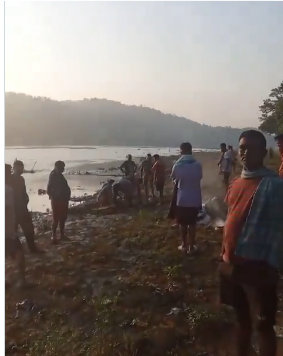
According to the reported accounts, local Christian tribal residents have opposed proposed cremation sites, with one formulation described by residents being that land could be provided if the bodies were buried, but not cremated. Hindu religious practice traditionally calls for cremation without the kind of prolonged delay that these circumstances impose. Yet families in Baghmara have been placed in the impossible position of waiting for darkness before carrying their dead to a remote riverbank, sometimes constructing makeshift platforms from banana trunks and timber because the river itself may be flooding.
The Meghalaya High Court has recognised that cremation according to one’s religious rites falls within the constitutional protection of religious freedom. In proceedings involving the Seng Khasi, the Court specifically recognised cremation as part of the Niam Khasi religious practice and treated access to a cremation ground as a matter engaging Articles 25 and 26.
A place containing a natural formation revered as Shiva by Hindu worshippers at Mawsynram, visited by hundreds of devotees for puja, was placed under a local institutional regime that sought to determine not merely who could enter the cave, but what religious acts could be performed there. In 2024, the Dorbar refused the No Objection Certificate required for the annual pilgrimage organised by the Yatra Society. The dispute reached the Meghalaya High Court, which intervened after the denial of permission for the religious rites.
The subsequent judicial process did not simply restore unrestricted Hindu ritual. In July 2025, the High Court permitted symbolic sprinkling of water on the stone formation but not the traditional pouring of water, while the petitioner undertook that no puja or ritual articles such as incense and flowers would be brought into the cave.
The Constitution does not protect Hinduism merely as an archaeological curiosity. It protects the right to practise religion. Environmental protection, public safety and preservation of a fragile cave are legitimate grounds for regulating how worship takes place. They should never become a convenient mechanism for determining whether worship may take place.
And in 2019, the removal of a Ganesha idol from NIT Meghalaya following pressure from the Jaintia Students Union became an extraordinary illustration of the problem. The institute removed the idol after the student body argued that its presence could generate “communal tensions.” That is precisely the kind of institutional asymmetry that deserves examination in a constitutional democracy.
The response to Meghalaya’s problem cannot consist of another committee, another compensation package or another temporary deployment of security forces after violence has already occurred. The record described above demonstrates that the problem is structural. It therefore requires structural intervention.
The objective should not be to weaken legitimate protection of indigenous communities. It should be to restore the constitutional distinction between protecting indigenous interests and permitting the permanent exclusion of other Indian citizens.
The State must protect indigenous culture without permitting ethnicity to become a licence for intimidation, religious discrimination, economic exclusion or violence by:
Initiating UAPA proceedings against the KSU with immediate effect
The Central Government should immediately examine the documented record of violence, intimidation, vandalism, mobilisation and repeated disruption associated with the Khasi Students’ Union and determine whether the statutory threshold for declaring the organisation an unlawful association under the Unlawful Activities (Prevention) Act, 1967 is met.
If the evidentiary threshold is satisfied, proceedings under Sections 3 and 4 of UAPA should be initiated without political hesitation. The matter must then proceed through the statutory Unlawful Activities (Prevention) Tribunal process.
There must be no selective application of national-security law. An organisation cannot repeatedly mobilise ethnic hostility, contribute to violent disorder and expect political status to function as immunity from the law. The entire leadership structure and financial ecosystem must be dismantled too.
Establishing an independent Minority Rights and Equal Citizenship mechanism as early as possible
The Union Government should establish a dedicated institutional mechanism for monitoring the rights of non-tribal and non-Christian citizens in Meghalaya, with particular attention to Bengali, Assamese, Gorkha, Bihari and indigenous non-Christian communities such as the Seng Khasi.
It should have an independent investigative function, a publicly accessible complaint mechanism and the authority to refer cases involving discrimination, intimidation, denial of access to essential services, unlawful obstruction of religious practice or economic discrimination to the appropriate Central and State authorities.
Creating a Central-monitored business and licensing hotline with immediate effect
A single-point complaint and escalation mechanism should be established for cases involving NOCs, trade licenses, commercial property access, municipal permissions, coercive closure of businesses and discrimination based on ethnicity or religion.
Complaints should receive a tracking number, a defined response period and an escalation route to a Central Government authority where local authorities fail to act.
Reforming discriminatory and excessively restrictive land-transfer mechanisms in the near future
The existing land-transfer framework must be reviewed to determine which restrictions are genuinely necessary to protect vulnerable tribal landholders and which restrictions unnecessarily prevent lawful economic activity by non-tribal citizens.
In particular, lawful transfer between non-tribal citizens should not be structured in a manner that leaves an owner with a severely restricted pool of potential buyers and consequently exposes that owner to coercive or artificially depressed prices.
A transparent appellate mechanism should also be created for rejected land-transfer applications.
Ensuring lawful access to cremation grounds and places of worship
No Indian citizen should have to negotiate with a local body for the basic right to perform constitutionally protected religious rites.
The State Government should identify and acquire adequate land for cremation grounds serving non-Christian communities wherever a demonstrated population exists. Such facilities should be administered through statutory local authorities rather than being dependent upon discretionary permission from informal community bodies.
The same principle must apply to lawful places of worship.
Building a parallel non-sectarian educational and healthcare network
The State, with Central assistance, should develop a strong network of schools, colleges, vocational institutes, hospitals and professional training centres that operate independently of religious control.
Special support should be provided to institutions established by Seng Khasi, Hindu and other indigenous or non-sectarian organisations, provided they meet the same academic, medical and regulatory standards applicable to every other institution.
Develop Meghalaya’s Hindu and indigenous heritage as a national cultural asset
Meghalaya’s Hindu heritage should not be treated as an alien intrusion into the state’s history.
The Nartiang Shakti Peetha, associated with Maa Jainteshwari, should form part of a wider eastern-Indian religious and cultural circuit linking major Shakti traditions, including Maa Kamakhya in Assam and Maa Tripureshwari in Tripura.
Connectivity, accommodation, sanitation, security, roads and public transport around these sites should be systematically developed.
At the same time, Meghalaya’s indigenous religious heritage, including Seng Khasi traditions and sacred natural sites, should receive serious patronage and sincere cultural revival efforts.
Rejecting unconstitutional demands for permanent exclusion
The Union Government should not accept any proposal whose practical purpose is to transform Meghalaya into a jurisdiction where an Indian citizen’s right to reside, work, trade, purchase property or practise religion depends upon his inherited ethnicity or religion.
Any Inner Line Permit or similar regime must therefore be examined strictly against the Constitution, applicable legislation and Supreme Court jurisprudence.
Protection of indigenous communities is legitimate. Permanent second-class citizenship for everyone else is not.
Audit the implementation of Scheduled Tribe protections
Scheduled Tribe protections exist to protect historically vulnerable tribal communities and their culture. They must not become a mechanism for political patronage, fraudulent claims or the permanent expansion of institutional privilege disconnected from the original purpose of the constitutional protection.
Meghalaya’s history raises a question the Indian State can no longer postpone:
What happens when legitimate protection of indigenous identity becomes a justification for excluding fellow citizens?
The answer is visible in decades of violence, displacement, destroyed homes and businesses, religious obstruction and institutional exclusion.
The deepest failure was not merely that violence occurred. It was that the State allowed violence to become a recurring instrument of political and demographic change.
The Meghalaya Government bears particular responsibility. Victims of earlier waves of targeted ethnic violence have waited for decades for meaningful justice, accountability, rehabilitation and adequate compensation. If the perpetrators were held accountable, then the injustice did not end when the streets became quiet.
The political culture that developed around the “outsider” transformed citizenship into an ethnic and religious test. The State did not merely fail to stop violence. It failed to defend equal citizenship against a political culture organised around inherited identity.
The consequences are particularly serious for non-Christian communities, especially those outside the institutional protection associated with Scheduled Tribe status. The restrictions documented in this report concerning religious practice, cremation, property, commerce and physical security raise fundamental questions about why successive State Governments have failed to protect their human rights and religious equality..
Not a single Meghalaya State Government elected since the late 1970s has shown sincere political will to protect indigenous culture without creating second class. This is why Meghalaya should not merely be called a failed experiment. It should be remembered as a warning story about what happens when citizenship is gradually replaced by belonging.
Once “Who belongs here?” becomes more important than “What rights does this citizen possess?” the constitutional order has already begun to erode. The Central Government must therefore do more than restore order after the next outbreak of violence. It must restore the principle that the Indian State belongs equally to the citizen who is locally powerful and the citizen who is locally vulnerable.
The Meghalaya Government must acknowledge victims, pursue legally possible accountability, address failures of compensation and rehabilitation, guarantee religious freedom, and ensure that no political, religious or community organisation can exercise a veto over constitutional rights.
The way forward is one law, equal citizenship, genuine indigenous protection, religious freedom, economic opportunity and uncompromising accountability for violence. Either Meghalaya becomes a warning from which the Republic learns, or a model that others learn to imitate to persecute fellow Indians.
India should choose the first.
====================================
If you love our work, you can help us by contributing a small amount of your choice.