What TV doesn't, print can't; we deliver.
What TV doesn't, print can't; we deliver.
What TV doesn't, print can't; we deliver.

Young Kuki men openly posed and smiled for cameras while holding a pistol and what appeared to be an assault rifle during the inauguration ceremony of the Saparmeina Turf Ground in Kangpokpi district of Manipur on March 24. This was not a covert display. It unfolded in plain sight, in a public setting, with no apparent attempt at concealment.
One of the individuals, identified as Issac Kuki, publicly acknowledged local photographer Ka Nam Jem Kuki, who commands a substantial digital presence with over 20,000 followers on Facebook. In another image, the same individual is seen standing armed in the presence of ChiChin Haokip, a regional singer with a significant online audience.
Incidents like these add to a growing body of evidence pointing toward the normalisation of military-grade weapons within everyday civilian life in regions of Manipur beyond the Imphal Valley.
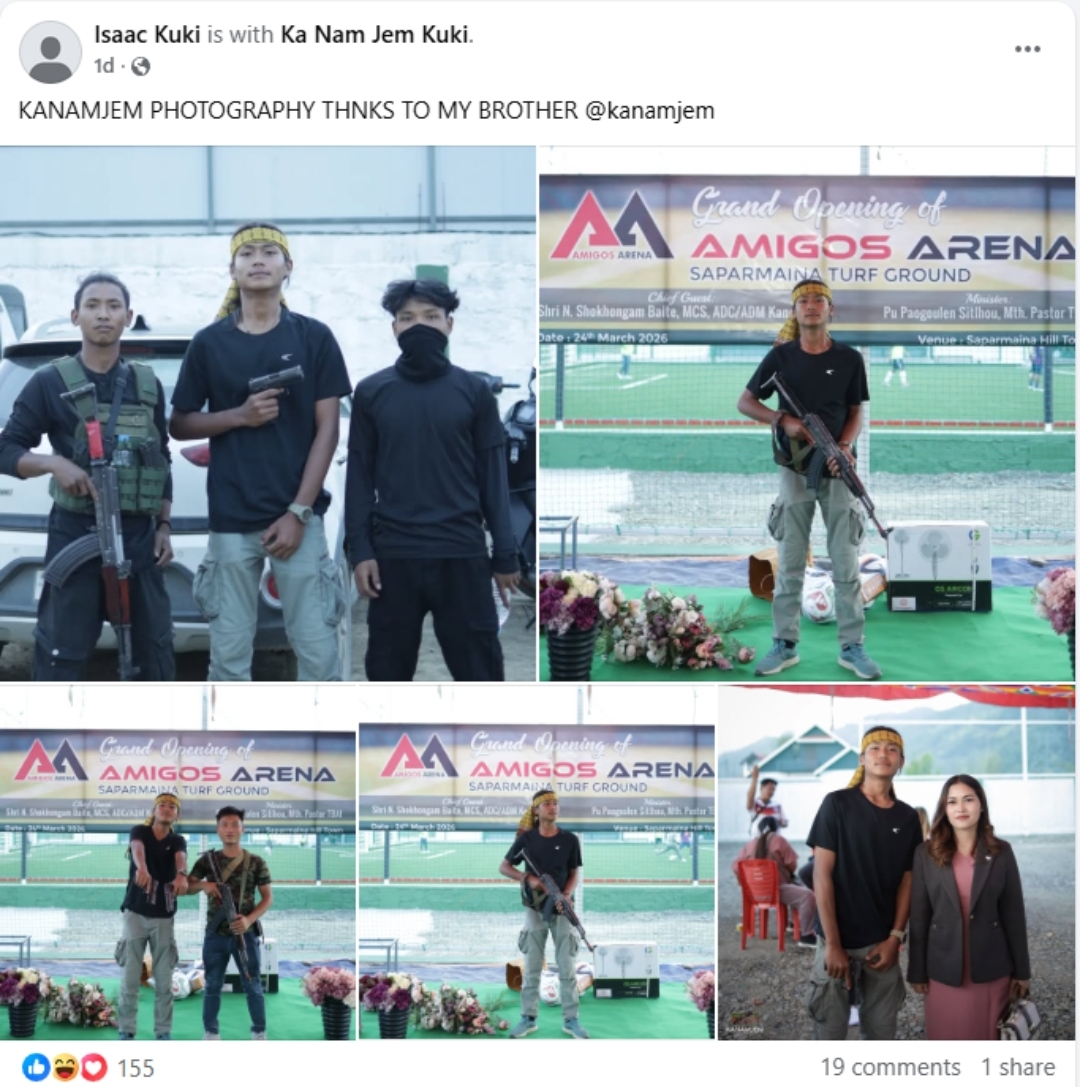

Issac Kuki posing with a weapon with regional singer ChiChin Haokip
A Kangpokpi-based WhatsApp group facilitating the procurement of military-grade weapons was uncovered on 18th March.
Taken together, these developments point to an uncomfortable yet inescapable conclusion that despite the extensive deployment of security forces across Manipur, weapons continue to flow into and circulate within the state, sustaining a gun culture that is steadily acquiring social legitimacy.
What is visible in photographs is only the surface. Beneath it lies a structured, adaptive ecosystem.
The challenge begins at India’s border with Myanmar.
The 1,643 kilometres long Indo-Myanmar International Border runs through some of the most inhospitable terrain in South Asia, including zones with :
As of March 2026, only 2.6% of the International Border has been fenced.

For enforcement agencies, this geography imposes logistical constraints. For illicit networks, it offers depth, concealment and flexibility.
Weapons flow into Manipur through multiple overlapping corridors:
This multiplicity is what gives the system its resilience. Disrupt one route, and weapons can be rerouted through other operational paths, sustaining the flow of weapons.
What operates within Manipur today is a decentralised logistics system.

Weapons are almost never transported in bulk or moved directly to their final destination. Instead, weapons are trafficked in stages. Small groups of five to ten individuals, carry them across short distances (rarely more than 30 kilometres) , avoiding main roads and relying on forest tracks and unmapped terrain. Along the way, transit camps, well-hidden caches and safe houses serve as temporary storage and redistribution points.
At the centre of this system is a distributed human network. Local porters, overground workers, and unemployed youth, many with no criminal record, form the backbone of the transportation system. Each group manages a defined segment of the route, handing off consignments in sequence, resembling a relay.
No single carrier moves the weapon across the entire distance. Instead, it is transferred zone by zone, often through individuals familiar with specific terrain corridors. This fragmentation provides a crucial advantage of plausible deniability. Even when apprehended, carriers rarely possess enough information to expose the broader network.

The persistence of this network becomes more striking when viewed against Manipur’s fragmented insurgent landscape.
Weapons moving across the state must pass through territories influenced by multiple armed groups, some of whom are in active conflict with one another. Naga insurgent factions dominate areas such as Tamenglong, while Kuki groups are influential in Kangpokpi and Churachandpur. Routes through Kamjong pass near active conflict zones between Kuki and Naga insurgent groups.
Yet the flow continues.
This is not accidental. It is transactional.
Allowing the movement of arms, often in exchange for informal taxation or protection payment, has proven to be more advantageous for the insurgent groups than obstructing it. The result is a form of shadow governance, where illicit flows are regulated rather than eliminated.
Public posturing against issues like narcotics cultivation by both Naga and Kuki insurgent groups coexist with a parallel tolerance for arms transit. The system sustains itself because it is simultaneously beneficial for multiple actors.
The state’s response, while substantial in manpower, reveals strategic limitations.
Security forces are heavily concentrated around the periphery of the Imphal Valley, prioritising the prevention of hit-and run attacks against residents by insurgent groups. While this approach addresses immediate high-impact threats, it leaves vast stretches of districts like Churachandpur, Kangpokpi, Pherzawl, Chandel, Tengnoupal, Kamjong and Tamenglong in an under-monitored state.
These are precisely the regions where terrain advantage, local familiarity and limited surveillance converge.
Static defensive deployments cede initiative by design. They create predictable zones of control while leaving fluid spaces in between. The weapons couriers exploit such gaps to traffic weapons.
The outcome is a paradox with high visibility of force, but limited disruption of flow.