What TV doesn't, print can't; we deliver.
What TV doesn't, print can't; we deliver.
What TV doesn't, print can't; we deliver.

A senior legal position advertised by IBN SINA Pharmaceutical Industry PLC, a company controlling a vast network of hospitals, diagnostic centers, medical colleges and training institutes across Bangladesh, explicitly bars women and non-Muslims from applying.
Their advertisement for “Executive/Senior Executive, Legal Affairs” role posted on 26 January 2026, specifies that candidates must be male and practicing Muslims in addition to holding an LLM.

This is not subtle bias. It is codified discrimination, violating international human rights standards, including the Convention on the Elimination of All Forms of Discrimination Against Women (CEDAW).
For decades, corporate discrimination in Bangladesh has been cloaked in vague policies or unwritten practices. IBN SINA has gone further by including exclusion into an official job description. Such a public declaration raises urgent questions about corporate ethics and accountability in the healthcare sector.
IBN SINA Pharmaceutical is controlled by the IBN SINA Trust, whose members maintain longstanding connections with Jamaat-e-Islami, a political party implicated for war crimes in Bangladesh’s 1971 Liberation War.
Key trust members include:
a) Prof. A.N.M.A. Zaher, director since 1983 and former chairman of Islami Bank Bangladesh Ltd.
b) Prof. Dr. Choudhury Mahmood Hasan, Prof. Dr. A.K.N. Sadrul lslam, Prof. Dr. Shamsuddin Ahmed, Dr. Mohammad Ayub Miah, Colonel (Retd.) Prof. Dr. Zehad Khan, and Kazi Harun or Rashid.
Historical records indicate that Jamaat-e-Islami leaders like Mir Quasem Ali played a key role in establishing and expanding the Ibn Sina Trust [1]. The trust itself was founded on 30th June of 1980 in collaboration with the Saudi government. The then Saudi ambassador Fouad Al Khatib and senior Bangladeshi legal figures had contributed financially.
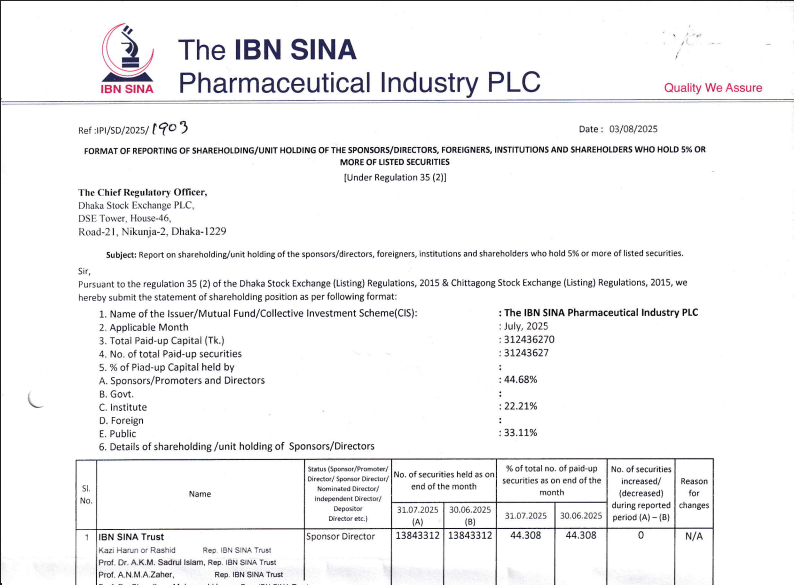
According to the company’s shareholding report (July 2025), the trust and its directors control 44.68% of IBN SINA, ensuring ongoing influence over corporate governance and operational policies.
The IBN SINA Trust is not a small operator. Its network spans dozens of institutions across Bangladesh, including:
Hospitals & Specialized Centers
a) Ibn Sina Specialized Hospital, Dhanmondi
b) IBN SINA Medical College Hospital, Kallyanpur
c) Ibn Sina Hospital & Diagnostic Center, Noakhali
d) Ibn Sina Hospital Sylhet Ltd
Diagnostic & Imaging Centers
e) Ibn Sina Diagnostic & Imaging Center, Dhanmondi
f) Ibn Sina Medical Imaging Center, Zigatola
g) Ibn Sina Diagnostic & Consultation Centers in Badda, Uttara, Lalbagh, Jessore, Bogra, Malibag, Savar and Mirpur
Training & Education
Ibn Sina Nursing Institute, Kallyanpur
Pharmaceutical & Laboratory Operations
a) Sina Pharmaceutical Industry
b) Ibn Sina D.Lab & Consultation Center, Doyagonj
This sprawling infrastructure touches thousands of employees and millions of patients. Institutional bias embedded in hiring can influence leadership, staffing and operational priorities. The scale of the IBN SINA network means that bias in one position can ripple across dozens of facilities, affecting staffing, patient care and management decisions throughout Bangladesh.
This is not the first time IBN SINA has been scrutinized. In 2013, the Intern Doctors’ Association of Bangladesh called for a boycott of the company’s products after it was revealed that Mir Quasem Ali, a convicted war criminal and Jamaat-e-Islami leader, had served as the marketing director o IBN SINA Pharmaceuticals and was a member of the Board of Directors of IBN SINA Trust [2][3].

IBN SINA’s overtly exclusionary job posting is a declaration of institutionalized discrimination. In a country where healthcare touches millions daily, the policies of a single corporate network can shape who has access to leadership, opportunity and influence. By codifying gender and religious barriers, IBN SINA is not just shaping its workforce — it is shaping the future of healthcare in Bangladesh and doing so along lines that have no place in a modern, equitable society.