What TV doesn't, print can't; we deliver.
What TV doesn't, print can't; we deliver.
What TV doesn't, print can't; we deliver.

A mob of approximately 30–50 individuals, conveniently labeled as “unknown miscreants”, carried out coordinated, selective attacks on properties belonging to Hindu families in the South Kamal Kachna Daspara area under Ward No. 24 of Rangpur, vandalising at least 6 homes and 1 shop.
The attacks were launched within 24-hours of the murder of youth political activist Rakib Hasan, who was brutally hacked to death in the Machhuapara Bazar area. According to police and local sources, the murder was allegedly orchestrated by a known drug dealer Momin after Rakib had confronted him over narcotics trade in the locality.
Eyewitnesses state that Rakib was lured from his home and taken to the Bazar, where he was attacked with sharp weapons in a savage and premeditated assault. He died on the spot.
But what followed had nothing to do with justice.
An armed mob had assembled near the South Kamal Kachna locality, an area known for it’s sizeable Hindu population, on the evening of 10th April.
Despite the fact that both the accused and the victim in the original murder case were Muslims, the armed mob had descended upon Hindu households, vandalising properties and terrorising residents.
Doors were broken. At least half a dozen homes and a shop were ransacked and vandalised, leading to severe economic losses and disrupting livelihoods.
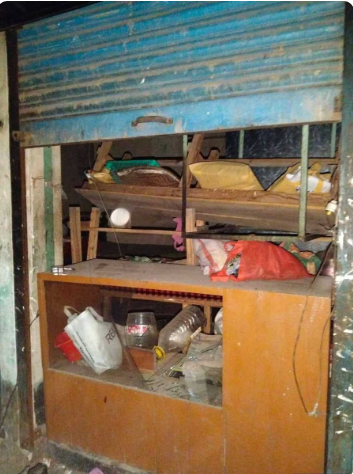
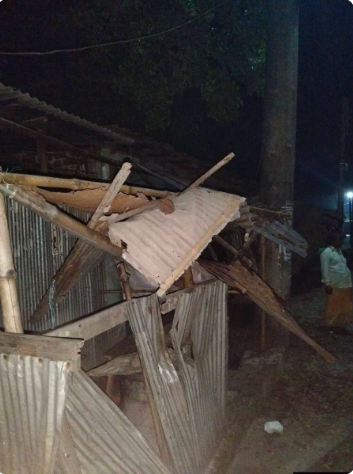
Eyewitnesses and victims report that the attack was deliberate and selective, with attackers identifying and targeting Hindu-owned properties.
One of the victims Pratima Das, reported that her shop was first vandalized in an unprovoked assault, followed by a second assault targeting residential properties.
“This was not spontaneous anger. This was targeted violence,” said one resident, speaking to Hindu Voice on condition of anonymity, a request that itself reflects the climate of fear now gripping the locality.
Even more disturbing than the violence itself is the response from those entrusted with upholding the law.
The conduct of Kotwali Thana’s Officer-in-Charge Azad Rahman raises serious and unavoidable questions. Even after the deployment of additional police forces following the attacks, he has publicly characterized the mob violence against Hindu residents as a “minor incident.”
Yet in the very same breath, the officer has assured swift and decisive action in the murder investigation of Rakib Hasan, allegedly killed by a drug dealer.
When one crime is met with urgency and institutional resolve, while another targeting religious minorities is minimized, the message conveyed is deeply troubling. It suggests not merely a gap in response, but a hierarchy of concern.
For the affected Hindu families, this disparity is more than symbolic. It shapes their expectations of justice, or the lack of it. When authorities appear to downplay targeted violence, confidence in due process erodes, and the promise of equal protection under the law begins to ring hollow.
Taken in isolation, the Rangpur attacks might be dismissed as a localized incident, but viewed against a broader historical backdrop, they appear far less coincidental and far more consistent with a troubling pattern.
Time and again, Bangladesh have seen violence redirected toward Hindu religious minorities, who often had nothing to do with the incident used as a pretext, yet bearing the consequences of it.
Recent history offers stark reminders.
Reports from the Gangachara region of Rangpur District described targeted attacks on Hindu households, echoing the same dynamics of selective identification and mob aggression in July 2025.
Earlier, during January–February 2025, Hindu families across several villages in the Birganj region of Dinajpur were reportedly confined to their homes for weeks, unable to step out even to procure essential supplies, an act of sustained intimidation.
These atrocities are not confined to any one political dispensation. They cut across governments, pointing instead to a deeper and more persistent failure of the unwillingness to consistently safeguard religious minorities.
Historical precedent reinforces this concern. Following the sentencing of Delwar Hossain Sayeedi for war crimes related to the Bangladesh Liberation War, Jamaat-e-Islami members and their supporters had launched nationwide attacks against Hindus. At least 50 Hindu temples were attacked and large over 1500 homes were looted or destroyed, with the victims bearing no connection to the judicial process that triggered the unrest.
The pattern is difficult to ignore:
Daspara now risks becoming the latest entry in this sequence.