What TV doesn't, print can't; we deliver.
What TV doesn't, print can't; we deliver.
What TV doesn't, print can't; we deliver.

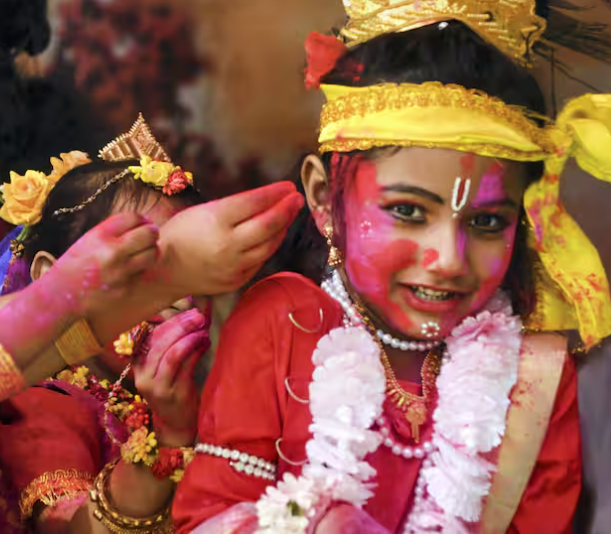
Every spring, when the air turns fragrant with shiuli’s memory and the first blaze of palash ignites the countryside, West Bengal steps into Dol Utsav, also known as Dol Purnima. It is Holi, yet rendered in a distinctly Bengali key, where colour carries scripture, music carries memory and processions become a living archive of devotion shaped over centuries.
Dol Purnima falls on the full moon of the month of Phalguna, aligning with ancient spring festivals described in Puranic literature, where Krishna’s playful leela with Radha is linked to colour, fertility and renewal.
The festival coincides with Gaur Purnima, the birth anniversary of Chaitanya Mahaprabhu (1486–1534), born in Nabadwip. With him, spring devotion became a public movement.
Temples place Radha and Krishna upon a decorated swing, the dol, from which the festival derives its name. Abir is offered not as mischief but as surrender. The application of colour is symbolic, where the devotee seeks to be “dyed” in divine love.
In Bengal, theology and season meet under the same full moon.
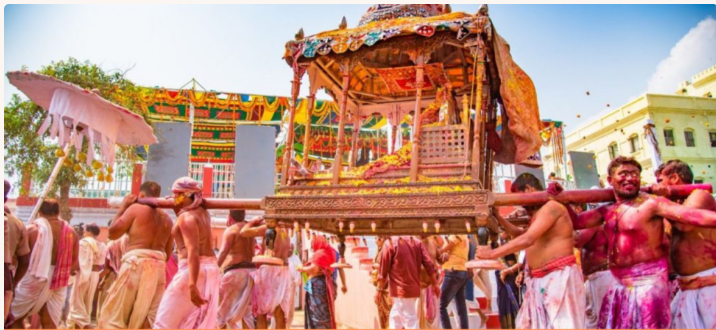
Any definitive account of Dol in Bengal must return to Nabadwip, the intellectual and spiritual epicentre of medieval Bengal and the birthplace of Shri Chaitanya Mahaprabhu.
In the early 16th century, Sri Chaitanya Mahaprabhu transformed devotional practice by taking kirtan, congregational singing of the divine name of gods, out of temple courtyards and into the streets. This was no mere ritual innovation. It marked a structural shift in the religious life of the region, relocating devotion from temple courts and elite patronage to the streets and the people. In doing so, it laid the foundation for mass movements rooted in shared faith rather than royal sanction, proving that spiritual authority could be generated collectively, sustained publicly and expressed without dependence on political power.
Dol, under his influence, became inseparable from Nagar Sankirtan or Nagar Parikrama — the sacred circumambulation of the town. Drums (khol), cymbals (kartal), and the rhythmic chanting of the maha-mantra turned civic space into sacred geography. The town itself became a shrine.

Across the river from Nabadwip lies Mayapur, now a global pilgrimage centre and headquarters of the International Society for Krishna Consciousness.
At the Sri Mayapur Chandrodaya Mandir complex, Dol Purnima unfolds over several days. Pilgrims from Europe, the Americas, Africa, and Southeast Asia gather for scriptural recitations, fasting, kirtan marathons and the midnight celebration of Chaitanya’s birth.
The Nagar Sankirtan here is immense, with drone camera footages showing beautiful waves of saffron and white moving rhythmically through the township as devotees perform rituals and chant the name Shri Krishna. If Nabadwip represents the historical heart of Dol, Mayapur represents its global afterlife. Bengal’s spring theology now travels across continents.
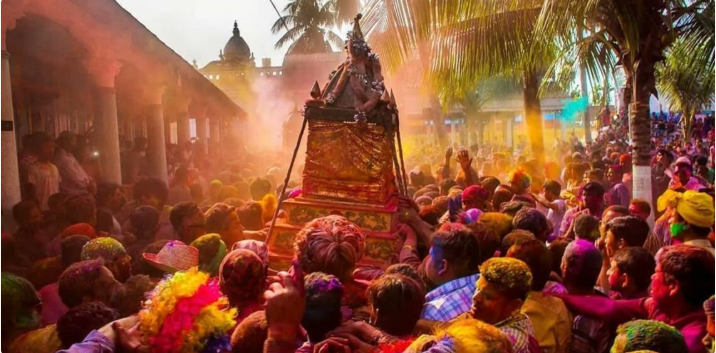
Rabindranath Thakur had institutionalised the Basanta Utsav, a cultural reimagining of Dol in 1923.
He did not abandon the festival’s Vaishnava inheritance, he deepened it. Without severing its devotional roots, he wove into it an ethic of aesthetic humanism, where beauty became a vehicle of spirituality, art a form of reverence, and celebration an expression of universal fellowship. Students dressed in basanti yellow sang Rabindra Sangeet, recited poetry, and applied abir gently to one another in choreographed celebration. Basanta Utsav is a reflection of his dream of shaping a modern Indian identity rooted in tradition yet free to innovate and express.
Basanta Utsav transformed Dol from a religious observance into a cultural emblem of Bengal itself without discarding its religious roots.

In Kolkata, institutions such as Rabindra Bharati University continue Tagore’s aesthetic legacy with organised song, dance, and disciplined celebration.
Simultaneously, traditional Vaishnava households maintain older rituals — idols on flower-laden swings, devotional kirtan through narrow lanes, neighbourhood Nagar Parikramas that echo centuries-old patterns.
Thus Dol in Bengal operates on multiple registers at once:
a) Temple ritual
b) Street procession
c) University festival
d) Global pilgrimage
e) Urban social gathering
Few festivals retain such layered continuity.

At its core, Dol Utsav in West Bengal expresses ananda, the divine joy that dissolves boundaries:
a) Between deity and devotee
b) Between sacred and civic space
c) Between scripture and song
d) Between medieval bhakti and modern humanism
Under the Phalguna full moon, Shri Chaitanya Mahaprabhu’s ecstatic procession, Rabindranath’s lyrical humanism and Mayapur’s global kirtan converge into a single seasonal statement, that joy can be theological, aesthetic and communal at once.
On Dol Purnima, Bengal does not merely throw colour. It re-enacts a history of devotion. It performs a philosophy of love.
And in doing so, it turns spring itself into scripture.