What TV doesn't, print can't; we deliver.
What TV doesn't, print can't; we deliver.
What TV doesn't, print can't; we deliver.
India is in the process of restoring full visa services for Bangladeshi nationals after an 18-month restriction driven by security considerations. As of March 2026, the government has initiated a phased reopening that includes tourist, business and student visa categories.
At first glance, this may appear to be a necessary correction that restores regional mobility, supports medical access and signals diplomatic normalization. However, recent enforcement data, persistent gaps in visa processing systems, and the documented presence of well-organized networks operating across multiple regions of India capable of providing high quality forged documentation at relatively low cost indicate a deeper structural challenge. Visa overstayers can exploit such forged documentation to evade detection, extend unauthorized stays and fraudulently assume the identity of legitimate Indian residents.
This structural weakness is further compounded by political resistance in key border states, where sections of the political establishment have treated Bangladeshi visa overstayers and illegal immigrants as embedded vote banks, actively obstructing identification and enforcement efforts.
At the same time internal instability in Bangladesh, including escalating violence against Hindu minorities and limited enforcement against extremist actors, introduces additional uncertainty into migration behaviour and compliance patterns.
Taken together, these factors suggest that administrative and enforcement capacity has not yet kept pace with the pace of policy expansion, raising serious concerns about the system’s readiness for further liberalization.

The persistence of visa overstays by Bangladeshi nationals in India has been repeatedly acknowledged in official disclosures by the Ministry of Home Affairs (MHA). In a written reply to the Rajya Sabha on 21.03.2012, the MHA had stated that 28,667 Bangladeshi nationals were overstaying their visas as of 31.12.2010, yet only 6,290 of them had been deported by the date of the reply. This pattern showed little improvement the following year with authorities detecting 24,364 Bangladeshi Visa overstayers as of 31.12.2011, of whom just 6,761 had been deported.
A decade later, the scale of the problem had expanded without any meaningful structural correction or resolution. Responding to Unstarred Question Number 5501 raised by Parvesh Sahib Singh Verma in the Lok Sabha on 05.04.2022, the MHA had disclosed that
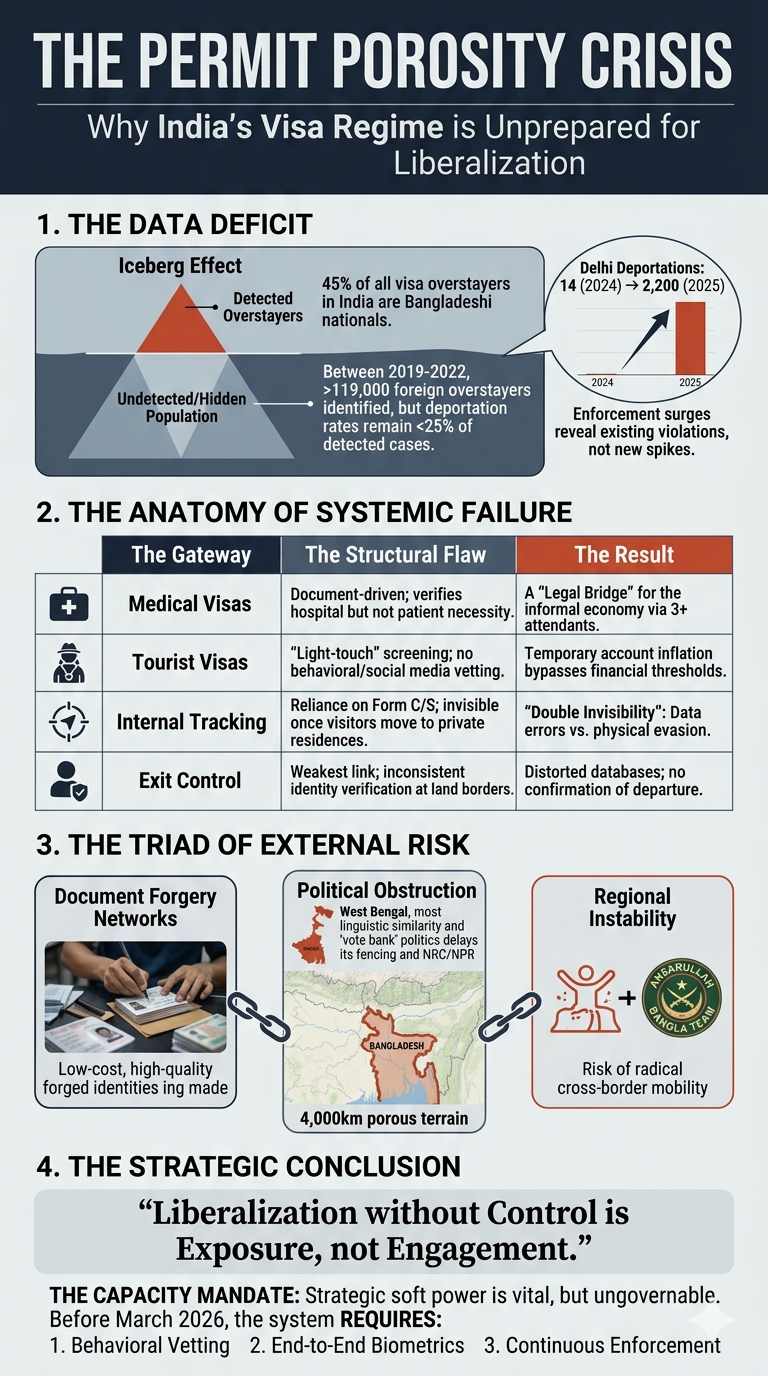
Available official data from 2009-2011 and again from 2019 through 2022 reveal a consistent pattern of Bangladeshi nationals accounting for approximately 40–45% of all visa overstayers in India.
Taken together, these figures underscore a deeply entrenched and cumulative problem. Visa overstays in India have persisted across years and policy cycles, reflecting systemic gaps in monitoring and enforcement that have remained insufficiently addressed for decades.
Recent enforcement patterns further illuminate the nature of the problem. Indian authorities had intensified verification measures and identification drives after the fall of the Awami League-led Government in August 2024. The resulting surge in detected cases of visa overstays reflects not a sudden spike in violations, but a delayed exposure of existing ones.
Ten Bangladeshi nationals were arrested in Outer Delhi on 13.03.2016 for residing on expired medical visas while attempting to secure onward medical visas to Bulgaria, suggesting the use of India as a transit base.
Six individuals from Bangladesh were detained from a hotel cluster in Park Street of Kolkata after overstaying their medical visas on 18.02.2026.
An identification drive in the Dwarka District of Delhi had led to the arrest of 8 Bangladeshi nationals for visa overstay in August, 2025.
81 out of the 104 deportations carried out in 2025 from Pune had involved Bangladeshi nationals, including documented cases of individuals residing with forged identities after visa expiry [2].
The most striking indicator of the enforcement gap emerges from Delhi itself where deportations of Bangladeshi nationals rose from just 14 in 2024 to approximately 2,200 in 2025 [1].
Viewed in totality, these data points converge on a consistent conclusion. Visa overstays by Bangladeshi nationals are not an emergent phenomenon driven by recent events but a structurally persistent issue, sustained over time by limitations in tracking, verification and enforcement. The tightening of border controls, increased vigilance by the Border Security Force along the Indo-Bangladesh border and a broader shift toward stricter monitoring have merely begun to reveal its true scale. The recent rise in detected cases of visa overstays should be interpreted not as a sudden escalation in violations, but as evidence that enforcement systems are only now beginning to capture the full extent of an already entrenched compliance deficit.

The Ministry of Home Affairs had rolled out the Immigration, Visa, Foreigners’ Registration and Tracking (IVFRT) system as a technological fix to a long-standing administrative problem in 2026. IVFRT has improved coordination, digitised records and enabled Indian missions abroad to communicate in real-time with immigration checkpoints and local enforcement units.
But technology cannot compensate for structural design flaws. India’s visa regime is still failing today because it trusts documents over verification, centralisation over coordination and detection over deterrence. The result is a system that is procedurally modern but operationally porous.
India’s VISA process remains fundamentally document driven at the front end, especially for high-volume medical and tourist visa applications from Bangladesh. Such a system is highly vulnerable against applicants using forged or illegally acquired documents.
Nowhere is this more evident than in the medical visa category.
To obtain a medical visa, an applicant typically needs :
a) A doctor’s recommendation in Bangladesh and
2) An invitation from an Indian hospital.
Indian missions do their part by verifying whether the hospital is legitimate, often checking accreditation with bodies like the National Accreditation Board for Hospitals and Healthcare Providers or the Indian Council of Medical Research. What they cannot realistically verify is whether the patient actually requires the treatment being cited.
In an environment where thousands of visas were processed daily till mid-2024, this gap is structural. Forged medical reports, exaggerated diagnoses and broker-generated hospital invitations can pass through a system that is designed to check format, not substance.
The problem does not end with the patient. Each medical visa permits up to three attendants, often with minimal scrutiny and not always limited to immediate family in practice. This creates a secondary channel of entry that is less examined, less monitored and easier to exploit. For some, the medical visa becomes a legal bridge into India’s informal economy.
Tourist visas present an even simpler route. They are intentionally “light-touch,” requiring fewer documents and minimal verification. But that efficiency comes at a cost. Financial thresholds can be bypassed through temporary account inflation. “Sudden deposits” appear just long enough to satisfy requirements and disappear just as quickly. Field verification, routine in higher-risk visa categories, is largely absent here, a casualty of sheer volume.
Unlike visa regimes in countries like the United States or the United Kingdom, India does not systematically integrate behavioural signals such as digital or social media footprints, into its screening process. The system evaluates what applicants submit, not how they behave.
India’s enforcement architecture is heavily front-loaded. Controls at the point of entry are comparatively robust. Beyond that point, the system fragments.
In theory, IVFRT integrates data across agencies. In practice, coordination gaps persist between the Bureau of Immigration and local enforcement bodies such as FRROs and state police. A person flagged in a central database does not automatically translate into a person located on the ground.
Tracking within the country relies on a simple assumption that foreigners will remain visible. Hotels are required to submit Form C and Educational institutions must file Form S. However, a significant number of visitors stay with relatives, acquaintances or in unregistered accommodations where no reporting takes place. At that point, the system loses sight of them.
Biometric integration, often cited as a solution, remains incomplete. Not all visa applicants are covered and exemptions for children and the elderly leave gaps in identity anchoring. Even where biometrics are collected, their utility depends on consistent use across entry and exit points.
The India–Bangladesh border, stretching over 4,000 kilometres through riverine terrain and densely populated regions , magnifies these weaknesses. Verification still relies on passport scans and manual stamping at many of the border checkpoints. Biometric systems are being introduced, but are not yet uniformly enforced at all the crossing points.
Exit tracking is the weakest link. Unlike more advanced systems, India does not consistently verify identity at departure, especially at land borders. The consequence is a distorted database where individuals who have left may still be recorded as present, while those who remain undetected blend into the background.
This produces what might be called a “double invisibility”, some overstayers are invisible to enforcement, while others exist only as data errors.
Even when overstayers exist in the system, enforcement is far from guaranteed. Responsibility for ground-level detection lies largely with state police “Foreigner Cells” operating under familiar constraints of limited manpower, competing priorities and the absence of sustained, nationwide mandates. Enforcement, as a result, is episodic. Special drives are conducted, the numbers of detected visa overstayers rise briefly and then attention shifts elsewhere.
In states such as West Bengal, Assam, and Tripura, the challenge is compounded by social reality. Linguistic, cultural and physical similarities allow individuals to assimilate with relative ease. Without continuous verification mechanisms, detection often occurs not through targeted enforcement, but by accident, during unrelated criminal investigations or routine policing.

This structural weakness is further compounded by political resistance in key border states, where segments of the political establishment have treated Bangladeshi visa overstayers and illegal immigrants as embedded vote banks, often obstructing identification and enforcement.
The most visible example is the All India Trinamool Congress government in West Bengal under Chief Minister Mamata Banerjee. Banerjee had stated that “all Bangladeshis living in Bengal are Indian citizens… they have been voting in successive elections” in 2020, reflecting a long-standing position that linguistic identity and electoral participation can substitute for formal citizenship. In line with this stance, the TMC Government has opposed the National Register of Citizens (NRC) and National Population Register (NPR), mechanisms designed to identify illegal residents, including visa overstayers [3].
On the ground, enforcement gaps remain significant. Large stretches of the Indo-Bangladesh border in West Bengal are still unfenced, with the Border Security Force (BSF) attributing delays to the State Government’s failure to provide land. The Calcutta High Court directed the state government to hand over land in nine border districts in January 2026, noting that compensation had already been disbursed and that delays were directly enabling illegal movement and smuggling [4].
Political intervention has also extended beyond state boundaries. When the Odisha Police had detained 444 individuals for identity verification in July 2025, the Trinamool Congress termed the exercise a “witch-hunt” and intervened on their behalf [5]. Similarly, the West Bengal Migrant Welfare Board has repeatedly approached courts to block deportations, asserting local residency for suspected illegal migrants, including visa overstayers.
A parallel dynamic is visible in Assam. Parties such as the All India United Democratic Front (AIUDF) and the Indian National Congress have challenged enforcement actions, arguing that verification drives risk wrongful exclusion. Following a BSF operation in May 2025, AIUDF leader Badruddin Ajmal alleged that “Indians are being declared foreigners,” AIUDF party leaders opposed the use of Form-7 objections during the 2026 electoral roll revision, citing concerns over targeted challenges against Bengali-speaking Muslims [6] [7].
This contestation has increasingly moved into legal and institutional arenas. TMC MP Sushmita Dev announced plans to pursue legal action against alleged misuse of electoral verification processes in January 2026, while Congress leader Gaurav Gogoi has consistently questioned the perceived selectivity of citizenship enforcement, particularly under the CAA–NRC framework. Civil society groups such as Citizens for Justice and Peace (CJP) have also expanded legal aid efforts for “suspected foreigners” contesting their status in Foreigners’ Tribunals.
Taken together, these political, legal and administrative dynamics create an environment where visa overstays are not merely a product of weak enforcement, but of contested governance where identification, verification and deportation are routinely delayed, diluted or challenged.

Available documentation points to an intensifying pattern of targeted violence against the native Bangladeshi Hindus accompanied by limited enforcement outcomes. Data compiled by Hindu Voice records 66 atrocities affecting at least 454 Hindu men, women and children during 12–28 February 2026, with visible investigative progress in only a small fraction of cases. The pattern appears to be continuing into March, with 45 additional incidents documented within the first two weeks. Taken together, these trends indicate continuing structural constraints in enforcement capacity occurring alongside an apparent intensification of persecution against Hindus.
Parallel to this, there are continuing indicators of radicalisation within segments of Bangladeshi society, particularly among sections of madrassa-educated youth. Organisations such as Jamaat-e-Islami retain a measurable presence in student political ecosystems.
Assessments derived from local reporting and public discourse suggest limited visible disruption of entrenched Islamist networks under the current Bangladesh Nationalist Party (BNP) administration. Individuals with established histories of radical affiliation like Jashimuddin Rahmani of Ansarullah Bangla Team and Harun Izhar, who has faced allegations of links with Harkat-ul-Jihad-al-Islami Bangladesh, Al-Qaeda and Lashkar-e-Taiba, continue to operate in the public domain. Their ongoing engagement through religious platforms such as Waz Mahfils, as well as through digital channels, indicates that their outreach capacity remains intact. The continued public visibility of convicted war criminals like Azharul Islam further reflects the limits of sustained accountability.
In this context, the absence of structured behavioural vetting mechanisms within the visa issuance framework represents a potential policy vulnerability. Expanded visa liberalisation, if not accompanied by calibrated screening protocols, may increase the likelihood of cross-border mobility among individuals with extremist affiliations, or those seeking to avoid domestic scrutiny. This risk is compounded by increasing disaffection among Bangladeshi people with segments of politically mobilised groups, including factions associated with the so-called “July Revolution.”
A recent case illustrates these dynamics. Ahmad Reza Hasan Mahdi, a district-level functionary of the National Citizen Party Bangladesh, who publicly acknowledged involvement in mob violence , including the burning of the Baniachong police station and the lynching of ASI Santosh Chowdhury, was detained in India while reportedly applying for a Finnish visa using a contract marriage arrangement in February 2026. The case highlights how enforcement gaps and mobility pathways can intersect, creating avenues for individuals implicated in serious violence to move beyond domestic jurisdiction.
The case for restoring visa access to Bangladeshi nationals rests on he three pillars of humanitarian necessity, economic interdependence and regional strategy.
Medical mobility is the most compelling. India functions as a critical healthcare corridor for Bangladeshi patients, particularly for specialised and repeat treatments. Interruptions in visa access risk breaking continuity of care with immediate welfare consequences.
Economic arguments are similarly grounded. Cross-border travel sustains demand across healthcare, hospitality and ancillary services, while business and student visas enable commercial linkages and human capital exchange.
At a strategic level, visa liberalisation is framed as a stabilising tool. Restrictive regimes can displace movement into informal channels, reduce state visibility over entrants and weaken India’s soft power in its immediate neighbourhood. In this framing, calibrated openness is less a concession than an instrument of managed engagement.

These arguments weaken at the point of implementation. They assume a level of state capacity that current systems do not yet possess.
Humanitarian pathways, especially medical visas, are structurally permeable. A document-driven approval process, combined with loosely regulated attendant entry, creates a dual-use channel that serves genuine patients but also enables low-friction transition into undocumented stay. In high-volume systems, even modest misuse rates scale rapidly.
Economic gains are also overstated when enforcement costs are excluded. Persistent overstays, identity fraud and informal labour absorption generate cumulative fiscal and administrative burdens on policing, verification systems and urban infrastructure that remain largely unaccounted for in liberalisation arguments. The result is a systematically biased cost–benefit assessment.
The strategic claim that tighter controls drive illegality misreads the risk structure. India does not face a substitution effect between illegal entry and visa overstay, it faces both concurrently. Expanding legal access without robust in-country tracking and exit verification does not reduce illegality, it increases the probability of status violation post-entry.
Comparative systems illustrate the gap. Migration regimes in the United States and the Schengen Area have moved toward integrated entry–exit tracking, biometric identity anchoring and overstay analytics. Even these systems report persistent compliance gaps despite far higher enforcement capacity. India’s current architecture, where exit verification remains inconsistent, biometric coverage partial and local enforcement fragmented, operates at a structurally lower baseline.
Finally, soft power is not a function of openness alone. It depends on credibility. A regime that expands access without enforcement coherence risks signalling administrative vulnerability rather than confidence.
The constraint, therefore, is not conceptual but institutional. The question is not whether visa liberalisation is desirable, but whether it is currently governable. On present evidence, it is not. Without prior strengthening of verification, tracking and enforcement, expanded access is likely to scale non-compliance rather than enable controlled mobility.
India’s move to restore full visa services for Bangladeshi nationals reflects a legitimate strategic instinct to revive mobility, sustain economic interdependence and stabilise regional engagement. But policy intent cannot substitute for institutional readiness.
The evidence presented here points to a deeper structural reality that India’s visa regime is not failing at the margins, it is misaligned with the scale of movement it is expected to govern. A system that verifies documents rather than individuals, fragments responsibility across agencies and treats exit as an administrative afterthought cannot enforce compliance at scale.
This is not, ultimately, a visa policy problem. It is a state capacity problem.
Persistent overstays, identity fraud, politically contested enforcement and the presence of organised facilitation networks indicate that non-compliance is not episodic, but embedded. Recent enforcement gains have not resolved this deficit, they have merely exposed it.
In such an environment, liberalisation does not operate as a neutral expansion of access. It functions as a multiplier of existing weaknesses. Every gap in verification, tracking and enforcement scales with inflow. The outcome is not greater openness, but diminished control, not managed mobility, but institutional blind spots at scale.
The strategic case for openness, therefore, requires inversion. Credibility in migration governance is not derived from how easily a system allows entry, but from how reliably it enforces exit. A regime that expands access without control does not project confidence — it signals administrative vulnerability.
None of this diminishes the case for engagement with Bangladesh. Medical mobility, economic exchange and regional stability remain valid objectives. But without enforcement coherence, these objectives rest on a system that cannot regulate the flows it enables.
The issue is not whether liberalisation is desirable. It is whether it is governable.
Governability is a function of sequencing.
a) Reform must not accompany expansion, it must precede any such measures.
b) Verification must occur before entry, not after violation.
c) Enforcement must be continuous, not episodic.
d) Tracking must be end-to-end, not partial.
Until these conditions are met, liberalisation is not a calibrated policy choice, but a structural gamble.
States do not lose control of migration by opening up. They lose control when openness is not matched by the capacity to enforce terms.
By that measure, India’s visa regime is not yet ready for full liberalisation.