What TV doesn't, print can't; we deliver.
What TV doesn't, print can't; we deliver.
What TV doesn't, print can't; we deliver.
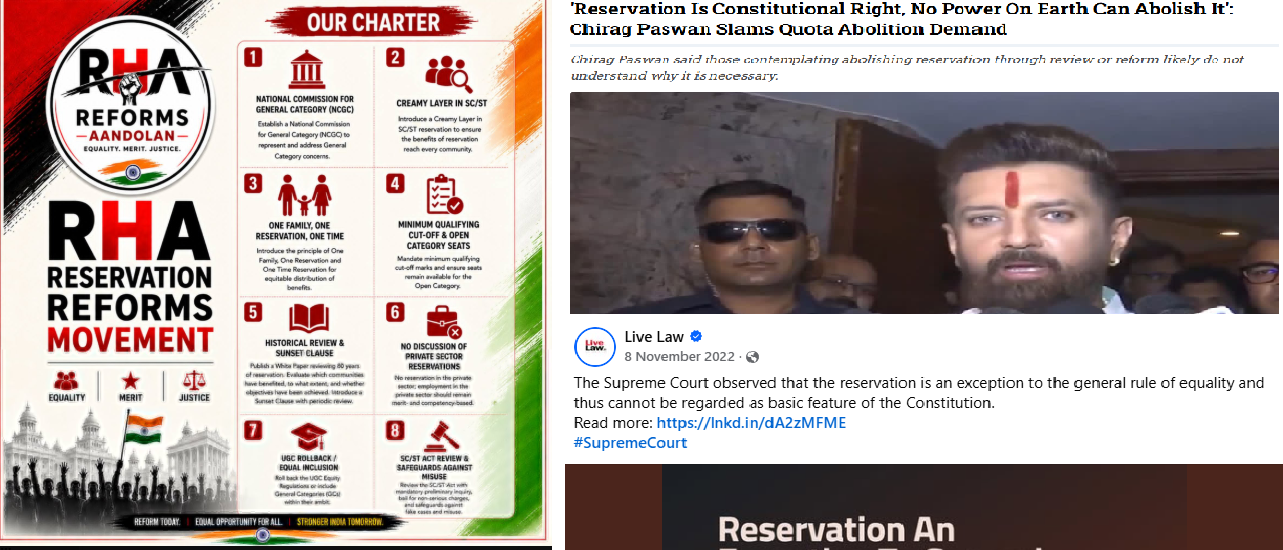
Hindu Voice Team: India’s reservation debate has been distorted by a series remarkably persistent constitutional misconceptions stating that :
1) Reservation is itself a fundamental right,
2) The Constitution guarantees every existing quota indefinitely and
3) Any attempt to reform or remove it is unconstitutional.’
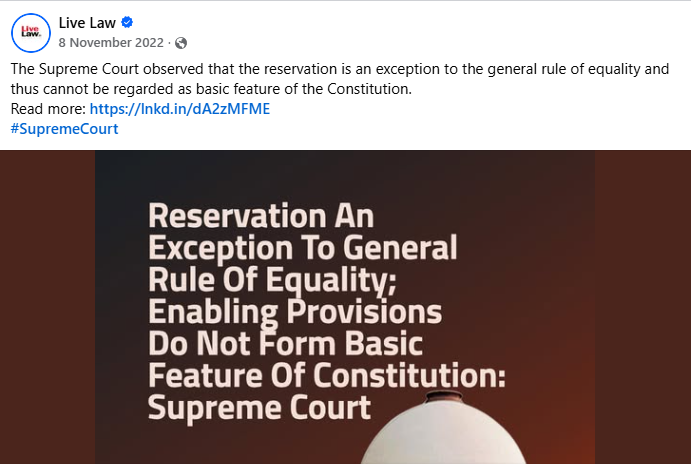
The Supreme Court has said otherwise.
In Ajit Singh v. State of Punjab, the Court was unequivocal: Articles 16(4) and 16(4A) do not confer a fundamental right to reservation. They are enabling provisions that give the State the power to provide reservation where the constitutional conditions warrant it. The Court also stressed that Article 16(1)’s fundamental guarantee of equality of opportunity must be harmonised with Article 16(4).
That distinction destroys the central myth. Equality is the constitutional guarantee. Reservation is one permissible instrument for pursuing it.
And an instrument cannot become a constitutional deity.
The Constitution does not say that every quota, percentage, eligibility concession or reservation policy enacted today must exist forever. Indeed, the Supreme Court has repeatedly recognised that reservation policy is subject to constitutional conditions, evidence and governmental judgment. In Mukesh Kumar v. State of Uttarakhand, the Court again held that there is no fundamental right to demand reservation and that courts cannot simply compel the State to provide it.
Therefore, the slogan that “removing reservation is unconstitutional” is legally meaningless without asking which reservation, under which constitutional provision, changed by what mechanism, and for what reason.
That is precisely where the Reservation Hatao Andolan deserves to be taken seriously, because their core demands reopen a constitutional question every political party has become too afraid to ask: does social justice require preserving every existing form of caste-based preference, or does justice require continuously testing whether those preferences actually reach those who need them?

The movement’s recent demands for a National Commission for communities classified as “General Category” greater weight to economic disadvantage, “quota within quota”, a comprehensive white paper, minimum academic standards and stronger EWS support—are, at their strongest, demands for targeting, transparency, accountability and institutional competence.
“Quota within quota” asks whether benefits within protected categories are actually reaching their most disadvantaged members. A white paper asks for evidence rather than political mythology. Economic assistance regardless of caste asks the State to help poverty wherever poverty exists. Minimum standards ask whether expanding access must come at the expense of maintaining institutional capability.
All of these propositions actually uphold the constitution.
A constitutional democracy should be able to reform an affirmative-action mechanism without being accused of attacking equality itself. If the objective is ultimately to create a society in which birth determines less, not more, of a citizen’s destiny, then India must eventually be willing to examine whether policies organised around inherited identities remain the best route to that destination.
The real question is :
“What system produces the most genuine equality, opportunity and social mobility for the greatest number of Indians?”
The Constitution guarantees equality.
It does not guarantee the permanence of any particular instrument used to pursue it.
And demanding that India remember that distinction is not an assault on the Constitution.
It is an insistence that the Constitution be taken seriously.