What TV doesn't, print can't; we deliver.
What TV doesn't, print can't; we deliver.
What TV doesn't, print can't; we deliver.
Hindu Voice Team:
Executive Summary
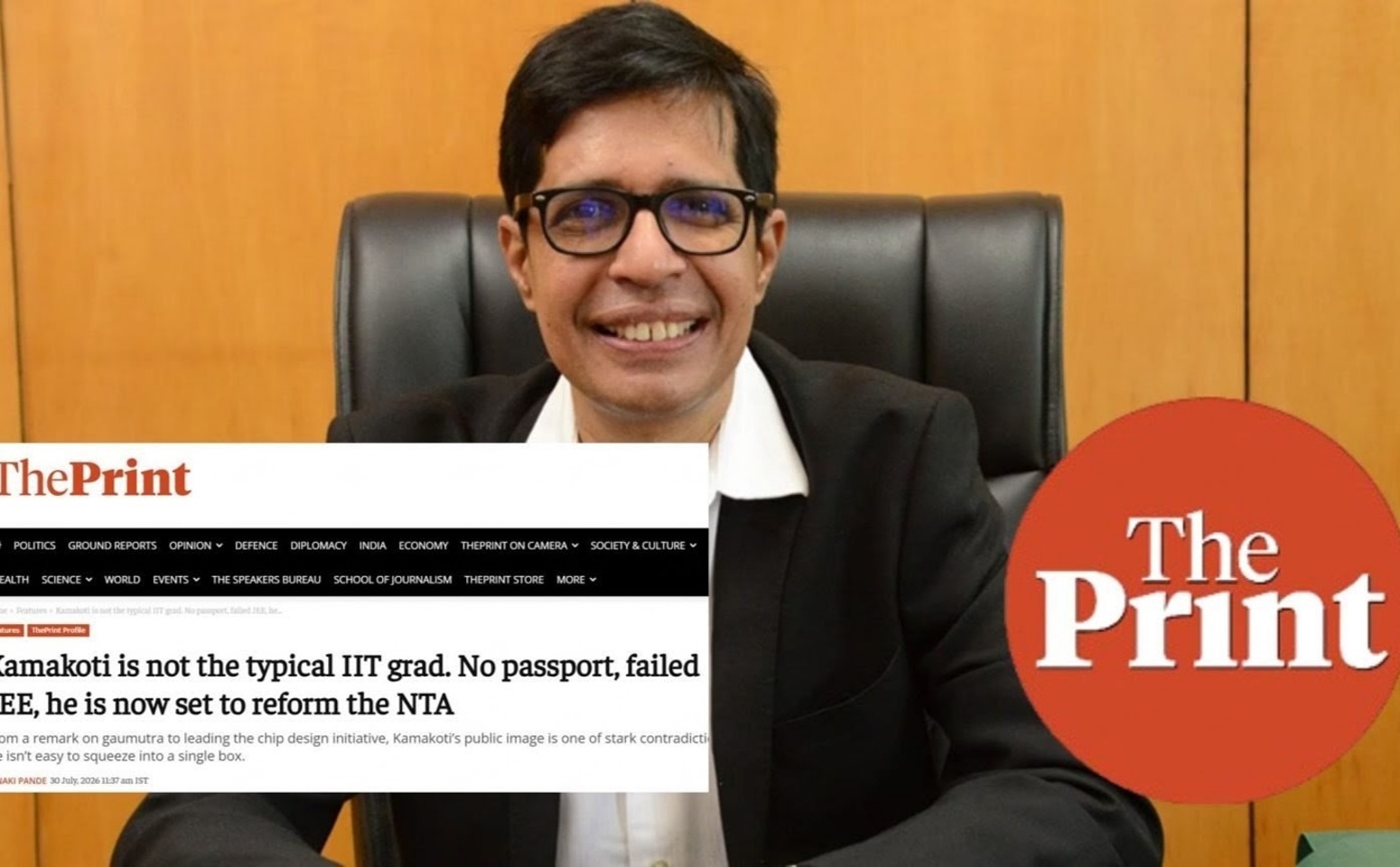
In contemporary digital journalism, the tension between editorial sensationalism and substantive reporting has reached a critical juncture. A prominent case in point involves a recent profile published by ThePrint regarding Professor V. Kamakoti, Director of IIT Madras, an internationally recognized computer scientist and Padma Shri laureate. While the body of the article detailed Professor Kamakoti’s national policy roles and upcoming responsibilities within the National Testing Agency (NTA) reform framework, the accompanying headline—focusing on historical failures rather than career milestones—sparked fierce backlash from media critics for prioritizing viral engagement over institutional stature.
The Anatomy of a Controversial Headline
The core of the journalistic dispute centers on a single editorial choice. ThePrint framed its coverage of a key national appointment around a provocative premise:
”Kamakoti is not the typical IIT grad. No passport, failed JEE, he is now set to reform the NTA.”
Critics argue that anchoring a profile of one of India’s foremost technological minds to trivial or distant setbacks—specifically, not clearing a single undergraduate entrance examination decades ago and not possessing a passport—creates an artificial narrative of anomaly. Rather than contextualizing his appointment through his extensive academic and administrative credentials, the headline constructs a hook designed primarily to stimulate algorithmic curiosity through controversy.
Divergence Between Headline and Substance
A rigorous examination of the report reveals a distinct disconnect between the framing and the content:
The Sensation vs. The Substance: While the headline leverages “failed JEE” and “no passport” as primary narrative hooks, the body text pivots toward substantive policy matters, including NTA structural overhauls, examination security protocols, and institutional reforms.
Omission of Major Milestones
The introductory framing omits critical achievements that substantiate Professor Kamakoti’s national standing, effectively burying a distinguished CV beneath social media-tailored clickbait.
Institutional Credentials of Prof. V. Kamakoti
To evaluate the public discourse accurately, observers must weigh the subject’s actual professional portfolio against the media portrayal. Professor Kamakoti’s academic and administrative trajectory includes:
Educational Foundation: Earned a Bachelor of Engineering, an M.S. by Research, and a Ph.D. from IIT Madras, followed by post-doctoral research at the Indian Institute of Science (IISc) and the Institute of Mathematical Sciences (IMSc).
Technological Leadership: Spearheaded the SHAKTI project, successfully delivering India’s first indigenous open-source processor family—a milestone for national technological sovereignty.
National Advisory Roles: Serves on the National Security Advisory Board, chaired the government’s Artificial Intelligence Task Force, and provides strategic technical counsel to federal authorities.
Recent Accolades: Honored with the Padma Shri in 2026 for distinguished contributions to science and engineering.
Broader Implications for Digital Journalism
The controversy underscores a growing ethical challenge within digital newsrooms: the pressure to utilize provocative framing to capture audience attention in crowded media ecosystems. When elite academic leadership and scientific achievement are filtered through the lens of social media bait, public discourse risks trivializing genuine merit in favor of sensationalist caricature.
(The above story is written based on a report published by The Commune. You can read the original report HERE )