What TV doesn't, print can't; we deliver.
What TV doesn't, print can't; we deliver.
What TV doesn't, print can't; we deliver.
There is a particular kind of suffering that neither roars nor erupts, that makes no demands and seeks no spectacle. It simply endures. It settles into the bones of a people, day after day, until endurance itself becomes a sentence. That is the life forced upon the people of Manipur today — a population trapped behind barricaded highways, punished by predatory airfares, and denied even the basic dignity of movement.
To grasp the scale of this quiet catastrophe, imagine a valley of 18 lakh people connected to the rest of India by just two narrow roads — two fragile arteries. Now imagine those arteries being remaining blocked for more than two years without relief or remorse. This is not a mere disruption. This is suffocation.
The Highways That Became Hostages
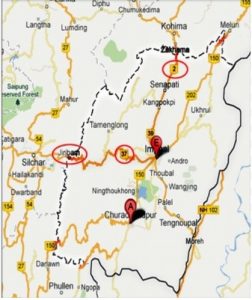
National Highways 2 and 37 are the veins through which the state breathes and survives. When NH2 is blocked, the pulse of Imphal Valley falters. When NH37 collapses under landslides and monsoon floods, the valley becomes an island surrounded by unforgiving hills.
Since May 2023, these roads have been held under a relentless siege. Travellers have been ambushed by armed Kuki-Chin-Mizo language–speaking militants. Barricades raised in the name of “peaceful protests” have hardened into months-long blockades. Trucks carrying essential supplies have been torched. Passengers, already exhausted by uncertainty, have been threatened. Consignments of food, medicine, fuel, and livelihoods have been left to rot on the roadside.
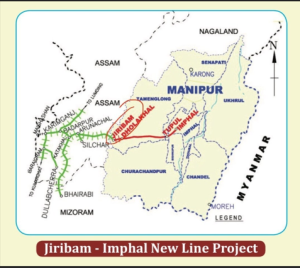
The only alternative route, the Imphal–Jiribam railway, offers little solace. Barely half of it is operational and even that stretch is reserved solely for goods trains inching through tunnels and across precarious bridges [4]. Passenger services remain suspended, victims of difficult terrain and the ever-present threat of violence. For the people of Imphal Valley, whose survival depends on the movement of goods and people, the absence of decisive action from the Central Government feels less like neglect and more like abandonment.
The Sky: Manipur’s Last Escape, Turned Into a Luxury
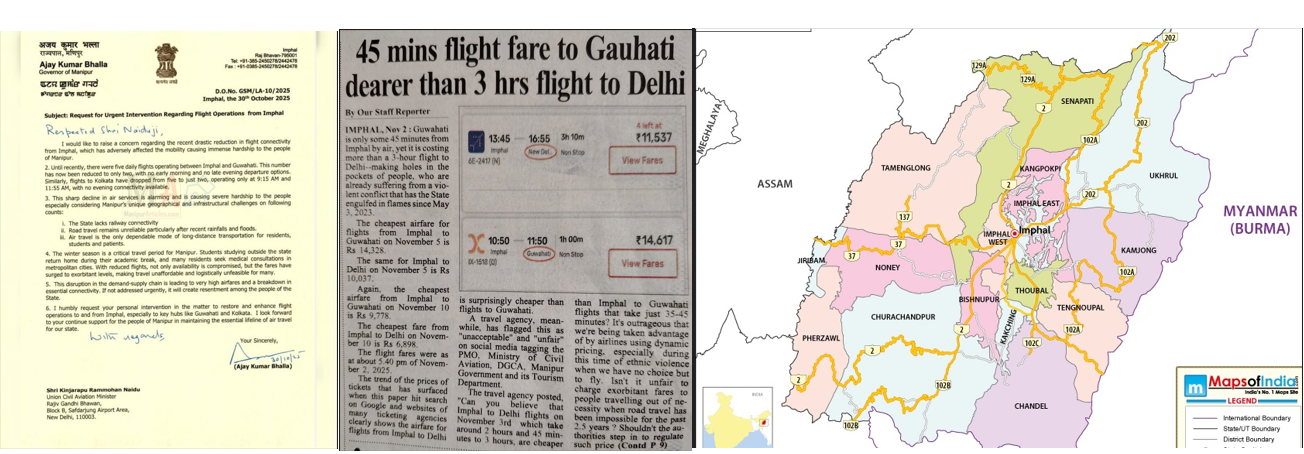
The demand for flight tickets had skyrocketed by late 2023 with airfares rising to absurd levels. Airfares in India have been deregulated since 1994. Airlines can charge what they want, when they want. The DGCA’s so-called “fare bands” have enormous gaps between the upper and lower limits, offering no real protection. When demand rises, algorithms take over, cold and amoral. A 40-minute flight under this band can legally cost anything between ₹2,000 and ₹6,000 [1]. That is the framework. In reality, Manipuris have been asked to pay two to three times the upper limit .By December, the price of flight tickets from Silchar to Imphal, barely a 94 kilometre hop across the hills, had soared to over ₹13,000. A delegation led by Janata Dal president Kshetrimayum Biren Singh met Governor Anusuiya Uikey, highlighting how exorbitant airfares were burdening residents of Imphal Valley and the internally displaced victims of the so-called “Manipur violence,” urging the government to provide subsidized airfares on 20.12.2023 [2].
Airfare from Silchar to Imphal in December 2023
MP A. Bimol Akoijam raised the issue of what he described as “daylight robbery” against the “tragedy-stricken people of Manipur” during his Lok Sabha speech in February 2025. On 03.11.2025, he had again pointed out that flight tickets in the Imphal–Guwahati sector, a 40-minute flight covering roughly 274 km, were being sold at ₹17,000–18,000, while the Guwahati–Delhi route, spanning about 1,450 km with a flight time of 2.5 to 3 hours, cost only ₹7,000–8,000. He reiterated that this disparity amounted to “daylight robbery” and accused the Government of India of being a “mute spectator” [3]. On 2 November 2025, a ticket from Imphal to Guwahati touched ₹14,617. Meanwhile tickets from Guwahati to Delhi, a three-hour flight, could be obtained at half the price. Bound by blockades below and bled by algorithms above, Manipuris remain trapped in a cage without bars.
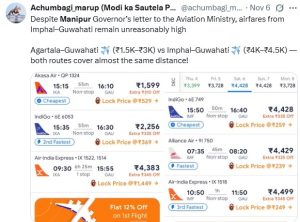
Governor Ajay Kumar Bhalla had written a letter to the Union Civil Minister K. R. Naidu on 30th October, highlighting how daily number of flights from Guwahati to Imphal was reduced from 5 to 2, further compounding the sufferings of people. He humbly requested the personal intervention of the Union Civil Minister and make sure that flight operations from Imphal be restored or enhanced. He mentioned how exorbitantly high airfares have made travel logistically unfeasible and unaffordable for most of the residents [5].
And yet, except for Air India Express voluntarily holding prices at ₹6,000, no action has been taken by either the DGCA or the Government. Airfares from Imphal to Guwahati continue to hover between ₹8,000 to ₹16,000 [6].
Livelihoods That Can No Longer Move
In Manipur, movement is livelihood. Mobility is survival. Nearly every small business in the valley, handloom workers, market vendors, carpenters, wholesalers, farmers, relies on moving goods in and out.
But what happens when goods cannot move?
Entrepreneurs who once supported families cannot even fetch raw material. Women vendors who depended on transport cannot reach markets. Artisans who lived off deliveries cannot ship anything out. Young men seeking work opportunities outside cannot afford the flight tickets. And for the tens of thousands of internally displaced people scattered across relief camps, the blockade is not an inconvenience, it is a double imprisonment of violence and prices that no citizen of any democratic nation should ever face.
A People Waiting to Breathe Again
Manipur’s pain is not loud. It is not theatrical. It is steady, patient, heartbreakingly dignified. A society cannot thrive when its roads are battlegrounds and its air routes are auction houses. A people cannot rebuild when every route out is blocked and every route in is overpriced.
This is not merely a matter of economics or logistics but a matter of whether 18 lakh Indian Citizens will be allowed to live with freedom of movement. Manipur survives today not because of the systems meant to support it, but in spite of them.
Because a land without open roads, without affordable skies, without the ability to move —
is a land being forced to stand still.
References :
[2] https://x.com/RajBhavManipur/status/1737860214576304160?s=20
[3] https://x.com/Bimol_Akoijam/status/1985692693780185526?s=20
[5] Letter from Governor Ajay Kumar Bhalla on 30th October
[6] https://x.com/koubru_lakpa/status/1989617233392283681?s=20